Dumbbell Exercise Ball Seated Lateral Raise

Overview
- Primary Focus:
- Shoulders.
- Equipment:
- Dumbbell and exercise ball.
- Difficulty:
- Beginner.
General Information
Dumbbell Exercise Ball Seated Lateral Raise is an isolation exercise that primarily targets the shoulders, with emphasis on the lateral head of the deltoid. It is a beginner-level movement that uses the instability of an exercise ball to add a mild core stability challenge to the standard lateral raise.
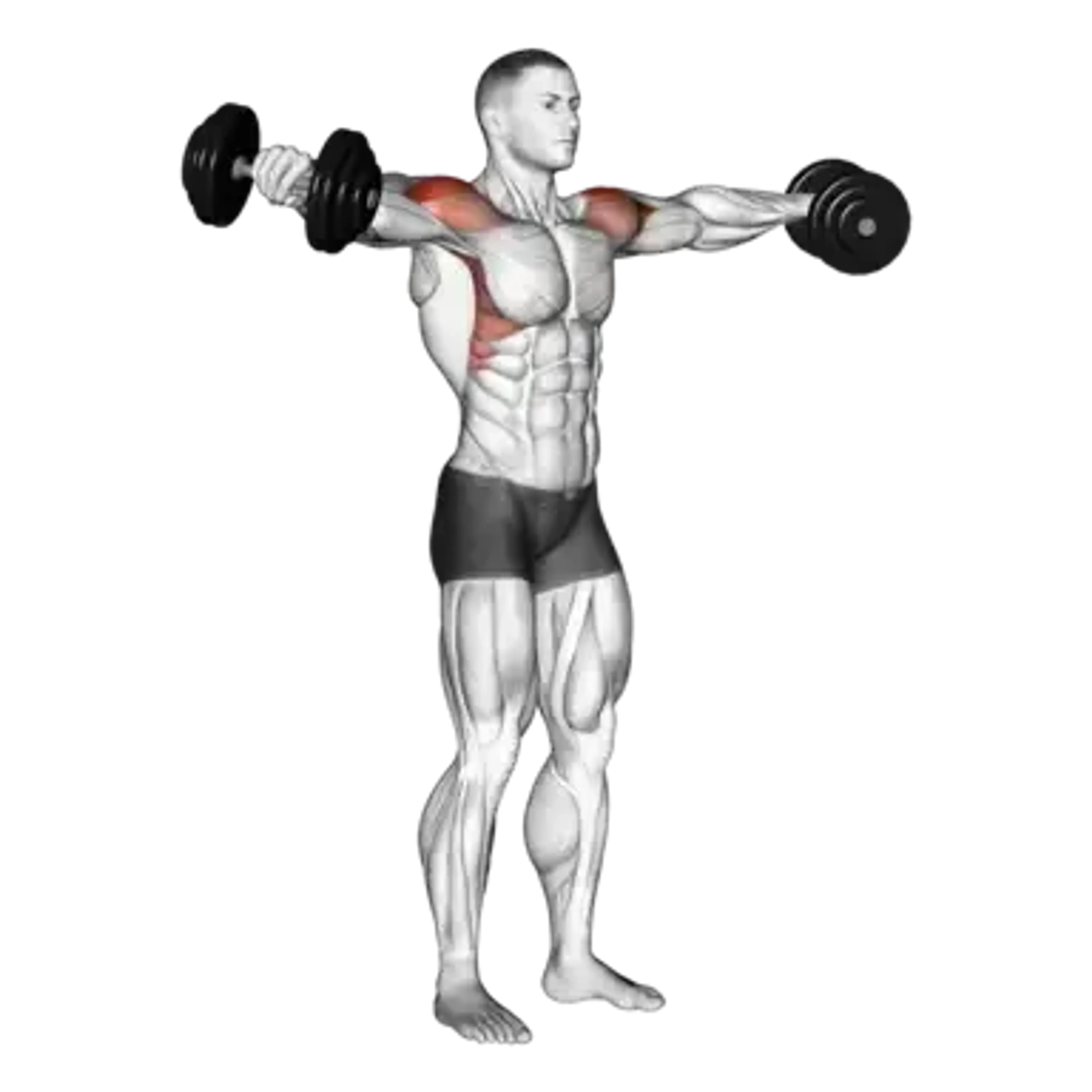
The movement involves sitting upright on an exercise ball with a dumbbell in each hand, then raising the arms out to the sides until they reach approximately shoulder height. The lateral deltoid does the majority of the work, with the upper trapezius assisting toward the top of the range of motion. Compared to standing variations like the Dumbbell Lateral Raise, the seated position reduces the ability to use body momentum, which keeps the emphasis on the target muscle.
The exercise ball seat eliminates the rigid back support of a bench, requiring the core muscles to maintain an upright posture throughout each set. This is a relatively mild stability demand compared to pressing movements on a ball, which is why the exercise remains accessible to beginners. The light loads typically used for lateral raises also reduce the risk of losing balance.
This exercise is an effective tool for building shoulder width and improving the appearance of the lateral deltoid cap. It fits well into shoulder-focused training days, upper body sessions, or as a finishing exercise after heavier compound pressing. Trainees who want to progress the stability challenge further can try performing the movement one arm at a time or with their eyes closed for a brief proprioceptive test.
Keep the movement controlled and deliberate. The lateral raise is most effective when performed with a weight that allows a slight pause at the top of each rep rather than swinging the dumbbells up with momentum.
Muscles Worked
- Deltoid
- Primary
- Serratus Anterior
- Medium
- Upper Trapezius
- Medium
- Erector Spinae
- Low
- External Oblique
- Low
- Rectus Abdominis
- Low
- Infraspinatus
- Minimal
Instructions
- Sit upright on an exercise ball with your feet flat on the floor, about shoulder-width apart.
- Hold a dumbbell in each hand at your sides with your palms facing inward and a slight bend in your elbows.
- Brace your core gently and keep your torso upright.
- Raise both dumbbells out to your sides in a wide arc, leading with the elbows.
- Continue raising until your arms are approximately parallel to the floor, with a slight bend maintained at the elbows.
- Pause briefly at the top of the movement.
- Lower the dumbbells back to the starting position in a slow, controlled manner.
- Repeat for the desired number of repetitions without using body momentum.
Common Mistakes
Injuries
Dumbbell Exercise Ball Seated Lateral Raise is a low risk exercise when performed with proper technique. The light loads and controlled arc of motion make it one of the safer shoulder exercises available, though a few precautions are still worth noting.
The shoulder joint can be irritated if the arms are raised too high above parallel or if the lifter internally rotates the shoulder excessively during the lift (the classic "pouring water" cue). Keeping the thumbs level with or slightly above the pinkies throughout the movement maintains a healthier shoulder position. Lifters with existing impingement or rotator cuff issues should limit the range of motion to just below shoulder height and use lighter weights.
The exercise ball introduces a small balance element, but because lateral raises use relatively light loads, the risk of a significant stability loss is low. If you feel unstable, widen your foot stance or switch to the standard Dumbbell Seated Lateral Raise on a bench until you are comfortable.
Stop the exercise if you experience pinching or sharp pain at the top of the shoulder. A brief warm-up with arm circles or band pull-aparts is sufficient preparation before performing lateral raises.
Alternative Exercises


Frequently Asked Questions
- Q: Why sit on an exercise ball instead of a bench for lateral raises?
The exercise ball removes back support, which engages the core to maintain posture and prevents you from leaning back to cheat the weight up. It adds a mild functional component without significantly changing the shoulder stimulus.
- Q: How heavy should the dumbbells be?
Lateral raises are most effective with moderate to light weights that allow strict form. Most trainees use 5 to 15 pound dumbbells. If you cannot raise the weight without swinging your body, reduce the load.
- Q: Should I rotate my wrists during the movement?
Keep your palms facing downward or slightly forward throughout the lift. Excessive internal rotation at the top can irritate the shoulder. A neutral or thumbs-slightly-up position is safest for most people.
- Q: Can I do this one arm at a time?
Yes, performing single-arm lateral raises on the ball increases the stability demand on the core since the load is asymmetric. Hold the ball or your thigh with the free hand for additional balance if needed.
Overview
- Primary Focus:
- Shoulders.
- Equipment:
- Dumbbell and exercise ball.
- Difficulty:
- Beginner.