Dumbbell Exercise Ball Seated Shoulder Press
Overview
- Primary Focus:
- Shoulders.
- Equipment:
- Dumbbell and exercise ball.
- Difficulty:
- Intermediate.
General Information
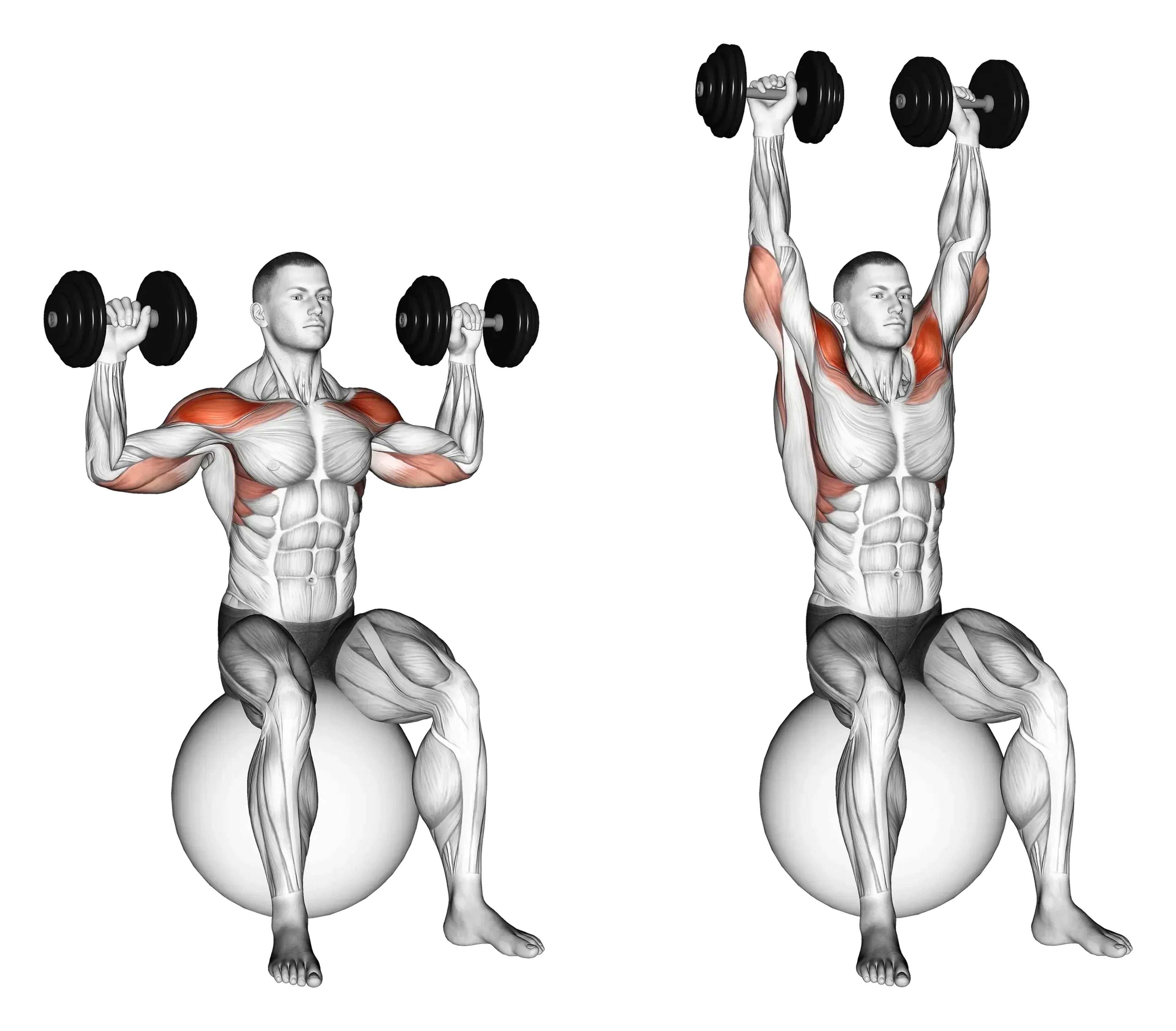
Dumbbell Exercise Ball Seated Shoulder Press is a compound exercise that primarily targets the shoulders and also engages the triceps, upper traps, and core. It is an intermediate-level movement that replaces the traditional bench with an exercise ball, adding a stability challenge to a classic overhead pressing pattern.
The exercise is performed by sitting on an exercise ball with a dumbbell in each hand at shoulder height, then pressing both weights overhead to full arm extension. The unstable surface requires constant engagement of the core musculature to prevent the body from shifting or tipping, which makes it a more demanding variation than a standard Dumbbell Shoulder Press on a fixed bench.
The anterior and lateral heads of the deltoid are the primary movers during the press, with the triceps contributing significantly to the lockout phase. The trapezius and serratus anterior assist with upward rotation of the scapula as the arms move overhead. Because there is no back support, the erector spinae and abdominal muscles must work together to maintain a stable, upright trunk position.
This exercise is particularly useful for athletes and trainees who want to develop shoulder strength alongside core stability. It translates well to sports that require overhead force production with a stable midsection, such as swimming, throwing, and martial arts. It also serves as a practical bridge between machine-based shoulder pressing and more demanding freestanding overhead work like the Barbell Overhead Press.
Maintain a controlled tempo and focus on pressing the dumbbells in a slight arc that finishes with the weights directly over the shoulders. Avoid leaning back or letting the ribcage flare as this undermines the stability benefit of the exercise ball.
Muscles Worked
- Deltoid
- Primary
- Triceps Brachii (Lateral Head)
- High
- Triceps Brachii (Long Head)
- High
- Rectus Abdominis
- Medium
- Serratus Anterior
- Medium
- Upper Trapezius
- Medium
- Erector Spinae
- Low
- External Oblique
- Low
Instructions
- Sit upright on an exercise ball with your feet flat on the floor, about shoulder-width apart or slightly wider for stability.
- Hold a dumbbell in each hand at shoulder height with your palms facing forward and elbows bent at roughly 90 degrees.
- Brace your core and maintain a neutral spine with your chest up.
- Press both dumbbells overhead by extending your arms, bringing them slightly together at the top.
- Fully extend your arms without locking out aggressively, keeping the weights over your shoulders.
- Pause briefly at the top with the dumbbells under control.
- Lower the dumbbells back to the starting position at shoulder height in a controlled manner.
- Repeat for the desired number of repetitions, keeping your torso stable throughout.
Common Mistakes
Injuries
Dumbbell Exercise Ball Seated Shoulder Press is a medium risk exercise when performed with proper technique. The overhead pressing pattern places significant load on the shoulder joint, and the unstable surface adds the possibility of losing balance under load.
The shoulder joint is the primary area of concern. Pressing overhead requires adequate shoulder mobility, and lifters with impingement issues or rotator cuff problems should approach this exercise with caution. If you lack the overhead range of motion to press without arching your lower back, address mobility first before adding load on an unstable surface.
The exercise ball amplifies the consequences of form breakdown. If the core fatigues before the shoulders, the torso may begin to lean or shift, placing asymmetric stress on the spine and shoulder girdle. Choose a weight that allows you to maintain strict form for all prescribed reps. If balance is a limiting factor, practice the movement with lighter dumbbells or consider the standard Dumbbell Shoulder Press on a bench until you build sufficient stability.
Stop immediately if you feel sharp pain in the shoulders, neck, or lower back. Warming up with band pull-aparts or light lateral raises before pressing is recommended to prepare the rotator cuff and scapular stabilizers.
Alternative Exercises


Frequently Asked Questions
- Q: Is this exercise suitable for beginners?
It is generally better for those with some pressing experience and comfort on an exercise ball. Beginners should first develop pressing strength on a stable bench and practice sitting on the ball with lighter loads before combining both challenges.
- Q: How does the exercise ball change the shoulder press?
The unstable surface forces the core and stabilizer muscles to work harder to keep you upright. This increases overall muscle recruitment beyond what a bench-supported press provides, though you will likely need to use slightly less weight.
- Q: Can I use this as my main shoulder pressing movement?
It can serve as a primary shoulder exercise in a program that prioritizes stability and functional strength. However, if maximal shoulder strength is the goal, a bench-supported or standing press will allow you to use heavier loads.
- Q: What size exercise ball should I use?
Choose a ball that allows your thighs to be roughly parallel to the floor when seated with feet flat. For most people this is a 55 cm or 65 cm ball depending on height.
Overview
- Primary Focus:
- Shoulders.
- Equipment:
- Dumbbell and exercise ball.
- Difficulty:
- Intermediate.