Exercise Ball Bench Dip

Overview
- Primary Focus:
- Triceps.
- Equipment:
- Exercise ball.
- Difficulty:
- Intermediate.
General Information
Exercise Ball Bench Dip is an isolation exercise that primarily targets the triceps and also engages the anterior deltoid and chest. It is an intermediate-level movement that combines the classic bench dip setup with an exercise ball placed under the feet, adding an instability challenge that increases core and lower body engagement throughout the movement.
In this variation, the hands are placed on a stable bench behind the body while the feet rest on an exercise ball in front. This elevated and unstable foot position extends the lever arm and forces the lifter to stabilize the ball with the legs while the triceps handle the pressing work. The result is a more demanding variation than a standard bench dip, both in terms of triceps load and overall body control.
This exercise is well suited for intermediate lifters looking to progress their bodyweight triceps training without adding external resistance. It works particularly well as a mid-to-late exercise in an upper body or push-focused session, where the added stability challenge provides a different stimulus than heavier pressing movements. It is also a practical option for home training, requiring only a bench and an exercise ball.
To get the most out of this movement, concentrate on a slow, controlled descent and a powerful press through the palms. Keep the core braced throughout to prevent the ball from rolling and to maintain a consistent body position from rep to rep.
Muscles Worked
- Triceps Brachii (Long Head)
- Primary
- Triceps Brachii (Medial Head)
- Primary
- Triceps Brachii (Lateral Head)
- High
- Deltoid
- Medium
- Pectoralis Major
- Medium
- Rectus Abdominis
- Low
- Serratus Anterior
- Low
- External Oblique
- Minimal
Instructions
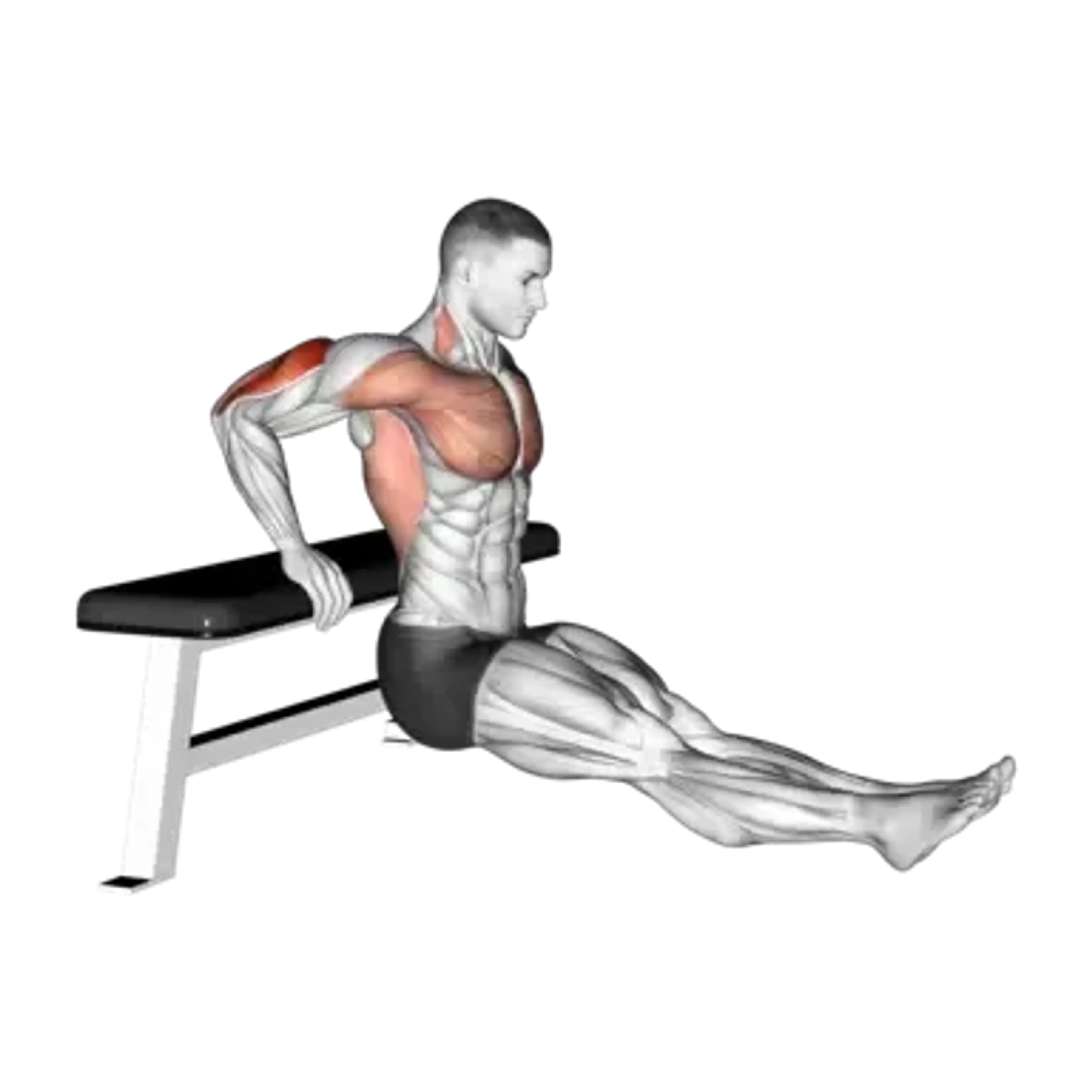
- Place your hands on the edge of a flat bench behind you, shoulder-width apart, with fingers curling over the edge.
- Position your feet on top of an exercise ball with legs extended in front of you.
- Lift your hips off the bench so your body weight is supported by your hands and feet.
- Keep your chest tall and your back close to the bench throughout the movement.
- Lower your body by bending your elbows, allowing them to point straight back.
- Descend until your upper arms reach roughly parallel to the floor.
- Press through your palms to extend your elbows and return to the starting position.
- Squeeze the triceps at the top before beginning the next repetition.
- Keep the ball as still as possible by engaging your core and legs throughout the set.
Common Mistakes
Injuries
Exercise Ball Bench Dip is a medium risk exercise when performed with proper technique. The combination of shoulder extension under load and an unstable foot platform creates two distinct areas of concern that lifters should manage carefully.
The most common injury risk involves the shoulder joint. As you lower your body, the shoulder moves into extension while bearing load, which places stress on the anterior capsule and rotator cuff. Descending too deep or letting the shoulders roll forward significantly increases this risk. Always control the depth and stop before your shoulders drop below your elbows.
The exercise ball under the feet adds a second layer of risk. If the ball shifts or rolls unexpectedly, the sudden change in body position can jolt the shoulders or cause a fall. Make sure the ball is properly inflated and positioned on a non-slip surface. If you find it difficult to control the ball, regress to standard bench dips with feet flat on the floor until your stability improves. Stop the exercise immediately if you feel any sharp or pinching pain in the shoulders or wrists.
Alternative Exercises


Frequently Asked Questions
- Q: What makes this harder than a standard bench dip?
Elevating the feet on an unstable exercise ball increases the percentage of bodyweight the triceps must press. The instability also forces the core and legs to work continuously to keep the ball from moving.
- Q: Can I do this with my feet on a flat bench instead?
Yes, placing your feet on a flat bench removes the instability component but still provides the elevated foot position. This is a good intermediate step if the exercise ball version is too challenging.
- Q: How do I progress this exercise further?
You can place a weight plate on your lap to add external load. However, only do this once you can comfortably control the ball for multiple clean sets of 12 to 15 reps.
- Q: Should I keep my legs straight or slightly bent?
Keep your legs extended for the full challenge. Bending the knees shortens the lever arm and makes the exercise easier, which can be used as a regression if needed.
Overview
- Primary Focus:
- Triceps.
- Equipment:
- Exercise ball.
- Difficulty:
- Intermediate.