Exercise Ball Decline Push-Up

Overview
- Primary Focus:
- Chest.
- Equipment:
- Exercise ball.
- Difficulty:
- Intermediate.
General Information
Exercise Ball Decline Push-Up is a compound bodyweight exercise that primarily targets the upper chest and also engages the shoulders, triceps, and core. It is an intermediate-level movement that combines the increased upper-chest emphasis of a Decline Push-Up with the instability challenge of an exercise ball under the feet.
With the feet elevated on the ball and the hands on the floor, the body angle shifts more load onto the upper portion of the pectoralis major and the anterior deltoids compared to a flat push-up. The exercise ball adds a balance component that is absent from a standard decline push-up performed with feet on a bench, making the core work substantially harder to maintain a straight body line.
This variation is particularly effective for developing upper chest size and pressing endurance without external load. The instability also recruits the serratus anterior and deep abdominal muscles to a greater degree than stable-surface push-up variations, making it a solid choice for functional upper-body training.
Exercise Ball Decline Push-Ups fit well into bodyweight training programs or as a finishing movement after heavier pressing work. They are a natural progression from the standard Exercise Ball Push-Up and the floor-based Decline Push-Up. Lifters who find this too easy can progress to slower tempos or add a weighted vest.
Maintaining a rigid plank from the ankles through the shoulders is essential. The ball will want to roll, so the legs and core must stay engaged throughout every repetition. Focus on pressing through the floor with a full range of motion while keeping the shins or tops of the feet firmly in contact with the ball.
Muscles Worked
- Pectoralis Major
- Primary
- Deltoid
- High
- Triceps Brachii (Long Head)
- High
- Rectus Abdominis
- Medium
- Serratus Anterior
- Medium
- Triceps Brachii (Lateral Head)
- Medium
- Erector Spinae
- Low
- External Oblique
- Low
- Rectus Femoris
- Minimal
Instructions
- Place the exercise ball on the floor and position yourself facing away from it.
- Place your hands on the floor slightly wider than shoulder width, then carefully set your shins or the tops of your feet on top of the exercise ball.
- Extend your body into a straight plank position, with your feet elevated and hands directly under your shoulders.
- Brace your core and squeeze your glutes to prevent your hips from sagging or hiking.
- Lower your chest toward the floor by bending your elbows, keeping them at roughly 45 degrees from your torso.
- Descend until your chest is just above or lightly touching the floor.
- Press back up by driving through your palms and extending your arms fully.
- Keep the ball as still as possible throughout the movement by engaging your legs and core.
- Repeat for the desired number of repetitions, maintaining a controlled tempo on each rep.
Common Mistakes
Injuries
Exercise Ball Decline Push-Up is a medium risk exercise when performed with proper technique. The elevated and unstable foot position increases demands on the shoulders, wrists, and core compared to standard push-ups.
The shoulders bear a greater percentage of body weight due to the decline angle, which can aggravate existing impingement or rotator cuff issues. If you experience anterior shoulder pain, reduce the decline by using a smaller ball or regress to a flat Exercise Ball Push-Up.
The wrists receive significant load in this position. Ensuring the hands are placed directly under or slightly in front of the shoulders helps distribute force evenly. Lifters with chronic wrist issues may benefit from using push-up handles to maintain a neutral wrist position.
The lower back is at risk if the core fatigues and the hips begin to sag. This is more likely to happen in later reps as the stabilizers tire. End the set when you can no longer maintain a straight body line rather than grinding out reps with a collapsed midsection.
Alternative Exercises

Frequently Asked Questions
- Q: Where should I place my feet on the ball?
Rest your shins or the tops of your feet on the ball. Placing only the toes on the ball increases instability and makes the exercise harder, while using the shins provides a wider contact area and more control.
- Q: How does this compare to a decline push-up on a bench?
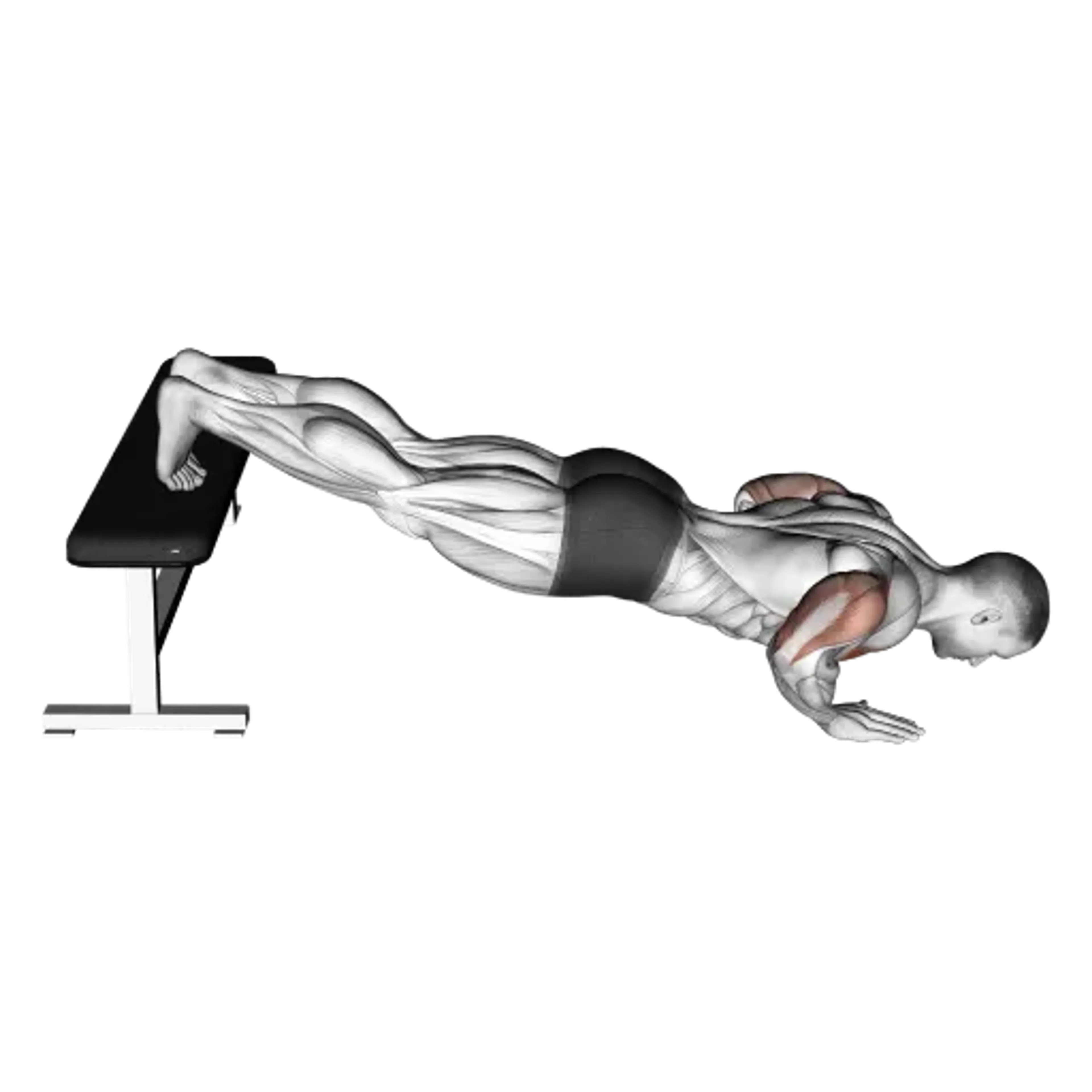
The pressing mechanics are similar, but the exercise ball version requires significantly more core and hip stabilizer engagement. You will likely perform fewer reps on the ball due to the added balance demand.
- Q: Can I use this to target the upper chest?
Yes. The decline angle shifts emphasis toward the clavicular head of the pectoralis major and the anterior deltoids, making it an effective bodyweight exercise for upper chest development.
- Q: What if the ball keeps rolling away?
Place the ball against a wall initially to limit its movement while you build the necessary stability. As your balance improves, move the ball away from the wall to increase the challenge.
Overview
- Primary Focus:
- Chest.
- Equipment:
- Exercise ball.
- Difficulty:
- Intermediate.