Exercise Ball Dip

Overview
- Primary Focus:
- Triceps.
- Equipment:
- Exercise ball.
- Difficulty:
- Intermediate.
General Information
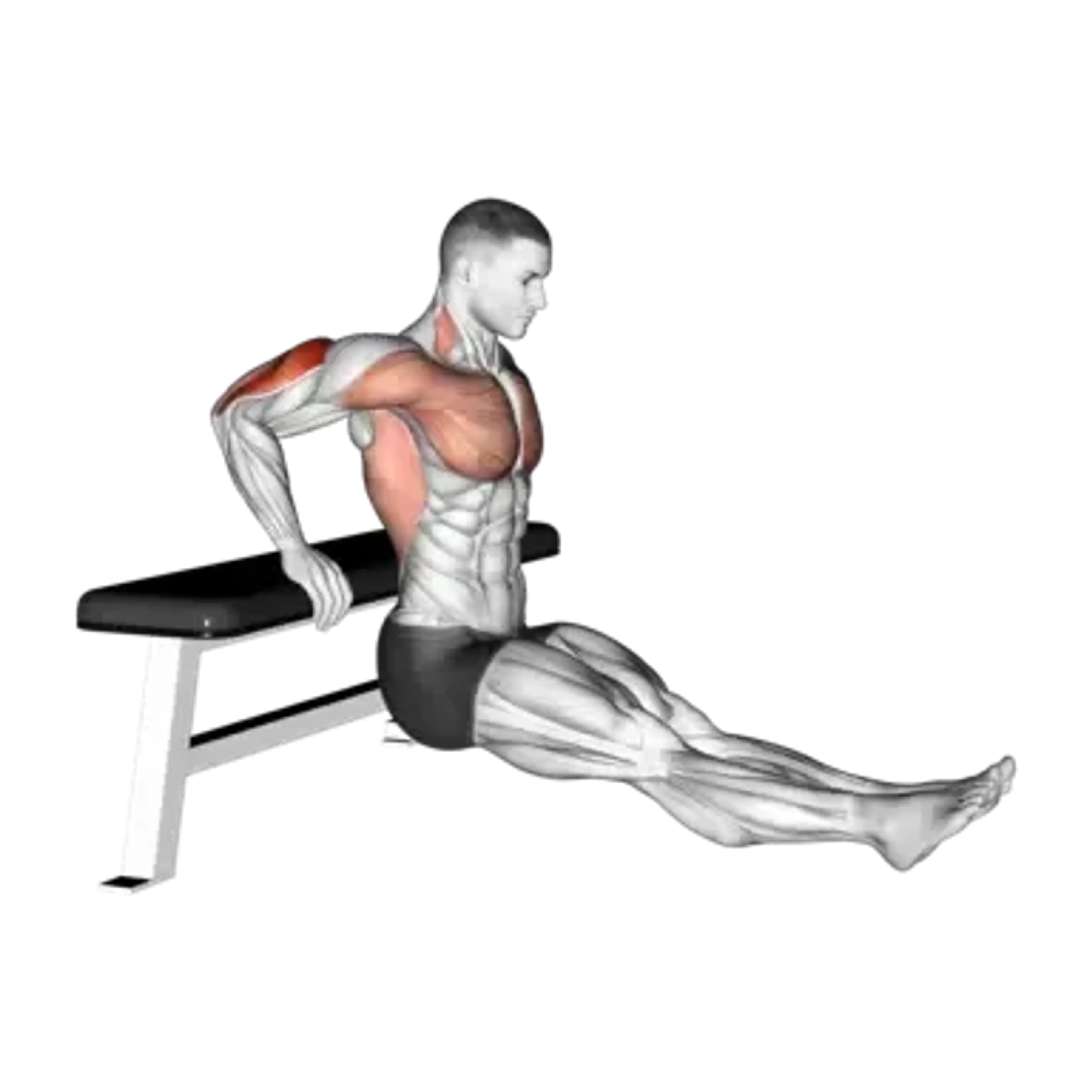
Exercise Ball Dip is an isolation exercise that primarily targets the triceps and also engages the shoulders and chest as secondary movers. It is an intermediate-level movement that uses an exercise ball as the base of support, which introduces an element of instability that demands greater core engagement and shoulder stabilization compared to a standard bench dip.
The unstable surface of the exercise ball forces the body to recruit additional stabilizer muscles throughout the movement. This makes the exercise particularly useful for athletes and lifters who want to build triceps strength while simultaneously training balance and proprioception. The dipping motion closely mirrors the mechanics of a traditional bodyweight dip, but the reduced stability shifts more demand onto the triceps to control the descent and drive the extension.
This exercise fits well into upper body or arm-focused training sessions as a bodyweight finisher. It can be used to develop pushing endurance after heavier pressing movements, or as a standalone triceps builder for those training at home with limited equipment. Because no additional load is required, it is accessible to a wide range of lifters who have progressed past beginner dip variations.
Mind-muscle connection is important here. Focus on pressing through the heels of the hands and squeezing the triceps at the top of each rep. Avoid letting the shoulders drift forward or the ball roll beneath you, as both reduce triceps engagement and increase joint stress.
Muscles Worked
- Triceps Brachii (Long Head)
- Primary
- Triceps Brachii (Medial Head)
- Primary
- Triceps Brachii (Lateral Head)
- High
- Deltoid
- Medium
- Pectoralis Major
- Medium
- Rectus Abdominis
- Low
- Serratus Anterior
- Low
- External Oblique
- Minimal
Instructions
- Sit on the exercise ball with your hands placed on top of the ball at your sides, fingers pointing forward.
- Walk your feet forward until your hips are off the ball and your arms are supporting your body weight.
- Keep your feet flat on the floor with knees bent at approximately 90 degrees.
- Lower your body by bending your elbows, allowing them to track straight back behind you.
- Descend until your upper arms are roughly parallel to the floor or you feel a comfortable stretch in the triceps.
- Press through the palms of your hands to extend your elbows and drive your body back up.
- Squeeze the triceps hard at the top of the movement before beginning the next rep.
- Maintain a tall chest and avoid letting your shoulders round forward throughout the set.
Common Mistakes
Injuries
Exercise Ball Dip is a medium risk exercise when performed with proper technique. The unstable surface adds a balance challenge that can lead to loss of control if you are not prepared, and the dipping position places meaningful stress on the shoulder joint, particularly the anterior capsule.
The primary injury concern is shoulder strain. Descending too deep or allowing the shoulders to roll forward places excessive load on the anterior deltoid and the shoulder capsule. Keep the descent controlled and stop before your shoulders drop below your elbows. Wrist discomfort is also common because the hands grip a curved surface; ensure your wrists stay neutral and avoid excessive extension.
If you are new to dips on an unstable surface, start with the standard bench dip to build baseline triceps strength and shoulder stability. Progress to the exercise ball version only once you can perform bench dips with clean form for multiple sets. If you experience any sharp pain in the shoulders or elbows, stop the exercise immediately and reassess your depth and hand placement.
Alternative Exercises
Frequently Asked Questions
- Q: How is this different from a regular bench dip?
The exercise ball creates an unstable base, which forces your core and shoulder stabilizers to work harder to keep you balanced. The triceps still do the primary work, but the overall demand on stabilization is significantly higher.
- Q: Can I add weight to this exercise?
It is possible to place a weight plate on your lap, but this is not recommended until you have excellent balance on the ball. The instability makes it difficult to control added load safely.
- Q: How many reps should I aim for?
Most lifters benefit from sets of 10 to 15 reps. Because this is a bodyweight movement on an unstable surface, higher rep ranges help build both muscular endurance and stability.
- Q: What size exercise ball should I use?
Use a ball that allows your thighs to be roughly parallel to the floor when seated. For most adults, a 55 cm to 65 cm ball works well.
Overview
- Primary Focus:
- Triceps.
- Equipment:
- Exercise ball.
- Difficulty:
- Intermediate.