Bodyweight Wall Squat
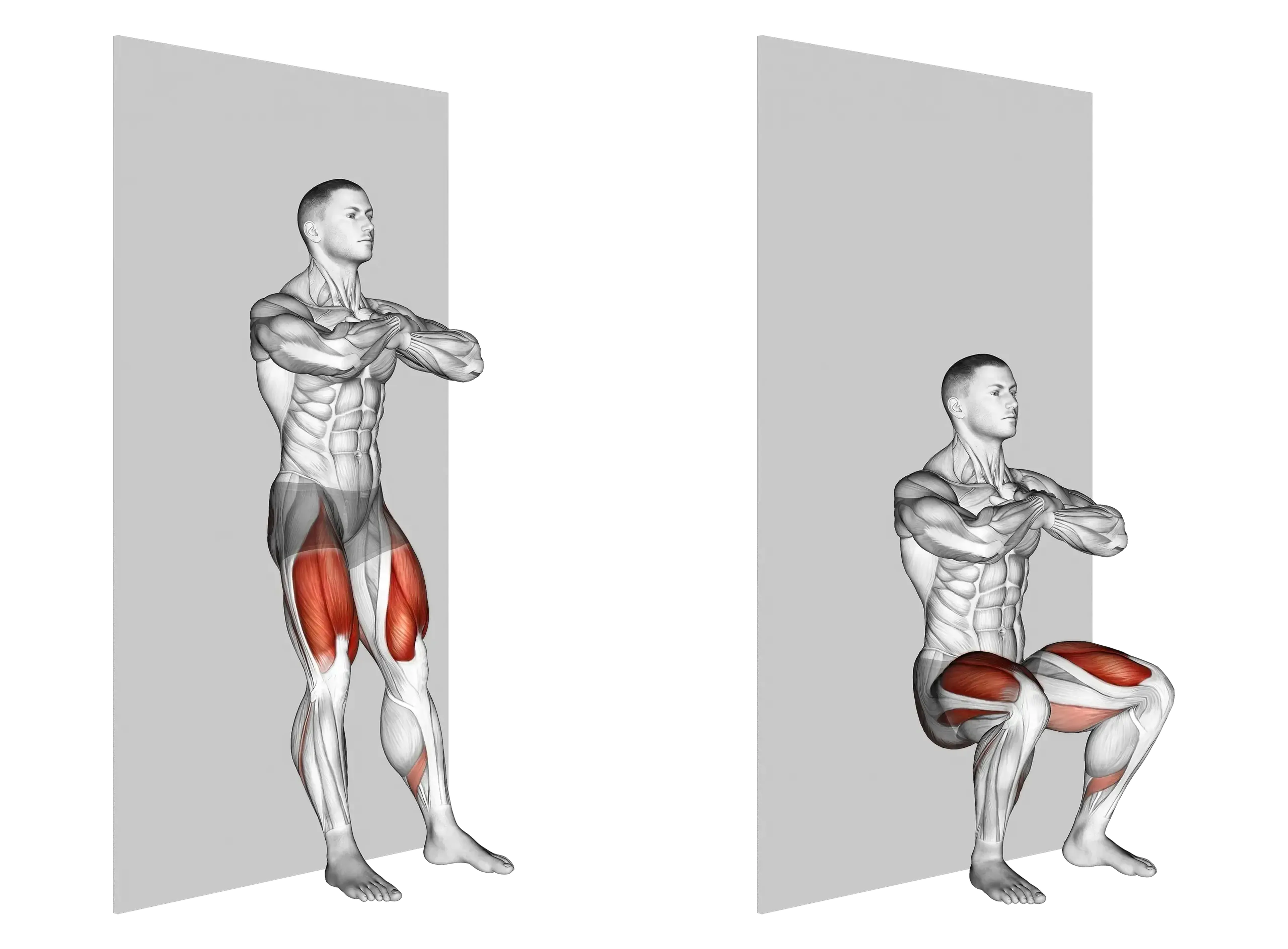
Overview
- Primary Focus:
- Upper legs.
- Equipment:
- Body weight.
- Difficulty:
- Beginner.
General Information
Bodyweight Wall Squat is an isometric exercise that primarily targets the quadriceps and also engages the glutes and adductors. It is a beginner-level movement that requires only a flat wall and is commonly used for building baseline quad endurance, rehabilitating knee injuries, and developing muscular stamina in the lower body. Because it is logged by time rather than reps, the goal is to hold the seated position for a target duration.
The wall squat involves leaning your back flat against a wall and sliding down until the thighs are parallel to the floor, then holding that position. The wall removes the balance component found in free-standing squats, allowing the lifter to focus entirely on quad contraction and mental endurance. Despite its simplicity, the isometric hold creates significant metabolic stress in the quadriceps, producing a deep burn that challenges even experienced lifters at longer hold durations.
This exercise is an excellent stepping stone toward dynamic movements like the Bodyweight Squat and serves as a useful accessory alongside loaded variations like the Barbell Squat or Machine Leg Press. For a progression that adds instability, the Exercise Ball Wall Squat uses a stability ball between the back and the wall.
To maximize quad engagement, focus on pressing your entire back flat against the wall and distributing your weight evenly through both feet. Avoid the temptation to rest your hands on your thighs, as this reduces the load on the quadriceps. Crossing the arms over the chest, as shown in the standard setup, ensures honest effort from the legs.
Muscles Worked
- Rectus Femoris
- Primary
- Vastus Lateralis
- Primary
- Vastus Medialis
- Primary
- Gluteus Maximus
- Medium
- Adductor Longus
- Low
- Gluteus Medius
- Low
- Soleus
- Low
- Erector Spinae
- Minimal
Instructions
- Stand with your back flat against a smooth wall and your feet roughly shoulder-width apart.
- Walk your feet out about two feet from the wall.
- Cross your arms over your chest or hold them straight out in front of you.
- Slide your back down the wall by bending your knees until your thighs are parallel to the floor.
- Ensure your knees are aligned over your ankles, not extending past your toes.
- Press your lower back firmly into the wall and keep your head and upper back in contact with the surface.
- Hold this position for the prescribed duration, breathing steadily throughout.
- To finish, press through your heels and slide back up the wall to a standing position.
Common Mistakes
Injuries
Bodyweight Wall Squat is a low risk exercise when performed with proper technique. The wall provides back support and eliminates the balance demands of free-standing squats, making this one of the safest lower body exercises available. It is frequently prescribed in physical therapy settings for knee rehabilitation and general lower body strengthening.
The primary concern is knee positioning. If the feet are placed too close to the wall, the knees will travel forward past the toes, increasing shear forces on the knee joint. Lifters with patellofemoral pain or patellar tendinopathy should keep the shin angle vertical and may benefit from holding at a higher position rather than full parallel.
Lower back discomfort can occur if the lifter allows a gap between the lumbar spine and the wall. Pressing the entire back flat against the surface helps maintain a neutral spine and prevents unnecessary spinal loading.
Frequently Asked Questions
- Q: How long should I hold a wall squat?
Beginners should aim for 20 to 30 seconds per set and work up to 60 seconds or longer. Once you can hold for 90 seconds comfortably, consider progressing to dynamic squatting movements like the Bodyweight Squat.
- Q: Is the wall squat good for bad knees?
Wall squats are frequently used in knee rehabilitation because the wall provides support and the isometric nature allows you to control intensity by adjusting depth. However, anyone with acute knee pain should consult a professional before starting.
- Q: How can I make wall squats harder?
Hold for longer durations, perform single-leg wall squats, place a weight plate on your lap, or try the Exercise Ball Wall Squat for added instability.
- Q: What muscles do wall squats target?
The quadriceps do the vast majority of the work during a wall squat. The glutes and adductors contribute as stabilizers, and the calves provide minor support at the ankle.
Overview
- Primary Focus:
- Upper legs.
- Equipment:
- Body weight.
- Difficulty:
- Beginner.