Exercise Ball Wall Squat
Overview
- Primary Focus:
- Upper legs.
- Equipment:
- Exercise ball.
- Difficulty:
- Beginner.
General Information
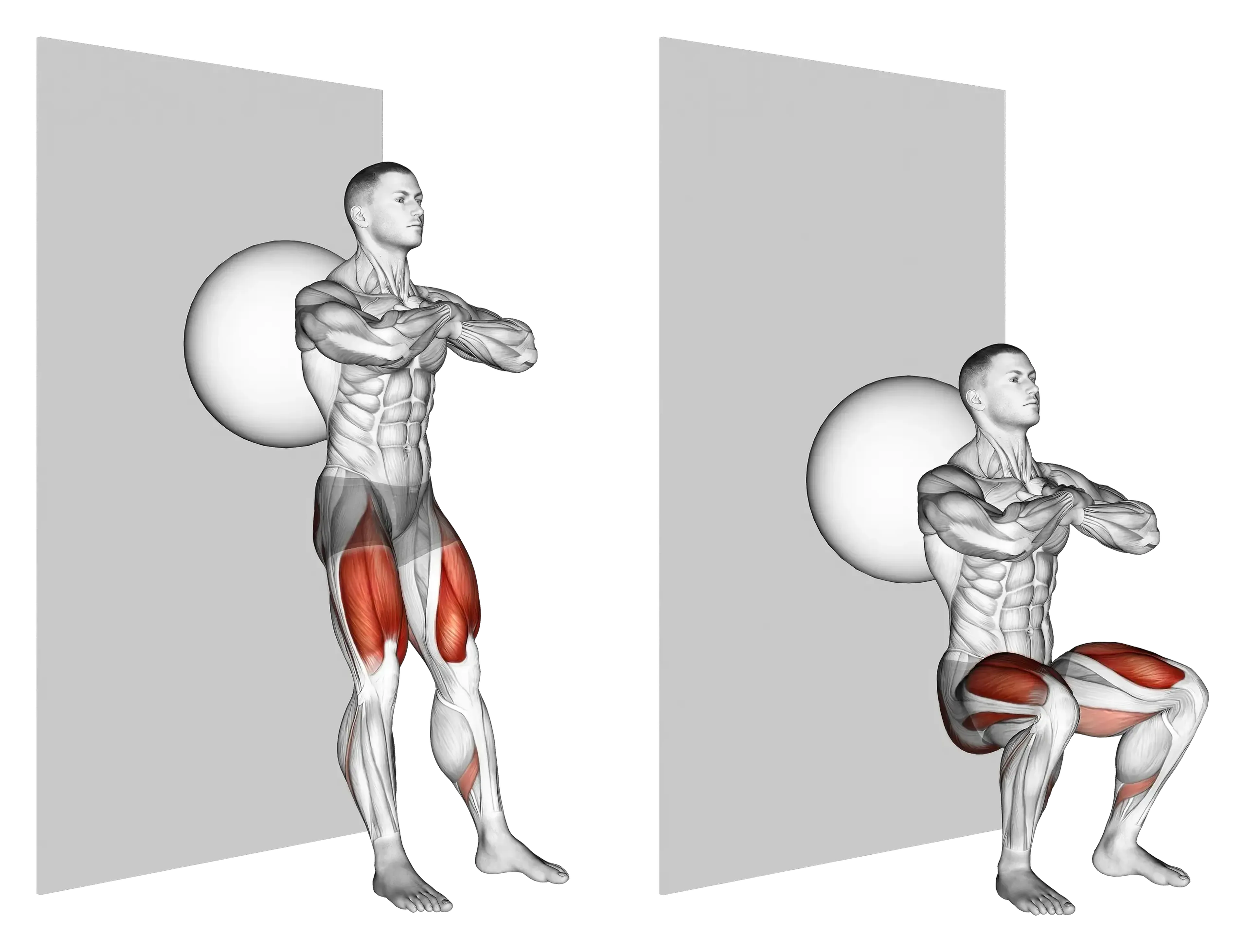
Exercise Ball Wall Squat is a compound exercise that primarily targets the quadriceps and also engages the glutes, adductors, and core. It is a beginner-level movement that uses an exercise ball pressed between the back and a wall to provide support and guide the squatting path.
The wall and ball combination removes much of the balance demand found in a free-standing bodyweight squat, making it an accessible entry point for new trainees, older adults, or those returning from lower body injuries. The ball rolls along the wall as you descend and ascend, encouraging an upright torso and a smooth, controlled tempo.
Because the torso stays more vertical than in a traditional squat, the quadriceps receive a greater share of the workload relative to the posterior chain. This makes the exercise particularly useful for building the vastus medialis and vastus lateralis, which are critical for knee stability and everyday movements like climbing stairs.
The exercise is commonly used in physical therapy settings and group fitness classes, but it also has a place in strength training programs as a warm-up or high-rep finisher. Once bodyweight becomes easy, the natural progression is the Weighted Exercise Ball Wall Squat with dumbbells.
Focus on pressing your back evenly into the ball throughout the movement. If the ball shifts to one side, it usually indicates asymmetric weight distribution between your feet, which should be corrected before adding load or volume.
Muscles Worked
- Rectus Femoris
- Primary
- Vastus Lateralis
- Primary
- Vastus Medialis
- Primary
- Gluteus Maximus
- High
- Adductor Longus
- Medium
- Gluteus Medius
- Medium
- Erector Spinae
- Low
- Rectus Abdominis
- Low
Instructions
- Stand with your back against an exercise ball that is pinned between your lower back and a wall.
- Position your feet shoulder-width apart and about one to two feet in front of your body, toes pointed slightly outward.
- Cross your arms over your chest or hold them straight out in front of you for balance.
- Brace your core and begin lowering your body by bending at the knees and hips, allowing the ball to roll down the wall.
- Descend until your thighs are approximately parallel to the floor, keeping your knees tracking over your toes.
- Pause briefly at the bottom of the squat.
- Press through your heels to drive back up to the starting position, rolling the ball up the wall.
- Repeat for the desired number of repetitions.
Common Mistakes
Injuries
Exercise Ball Wall Squat is a low risk exercise when performed with proper technique. The wall support and bodyweight-only load make it one of the safest lower body exercises available.
Knee discomfort is the most common concern, usually caused by letting the knees drift too far forward over the toes. Positioning the feet further from the wall typically resolves this by keeping the shins more vertical at the bottom of the squat. Individuals with existing knee conditions should start with a shallower range of motion and deepen it gradually.
The lower back is well supported by the ball, but if the ball is placed too high or too low on the back, awkward spinal positioning can occur. The ball should sit in the curve of the lower back at the start and roll to the mid-back region at the bottom of the squat.
Stop the exercise if you experience sharp knee pain, any popping or clicking in the joints, or if the ball slips out of position. Wearing shoes with good traction and using a properly inflated ball helps prevent slipping.
Alternative Exercises



Frequently Asked Questions
- Q: How deep should I squat?
Aim for thighs parallel to the floor. If you cannot reach parallel without discomfort, squat to whatever depth you can control and work on increasing it over time.
- Q: Can I hold this as an isometric wall sit instead?
Yes, holding the bottom position for time is a valid variation that builds muscular endurance. This is commonly called a wall sit and works well as a finishing exercise.
- Q: What is the benefit over a regular bodyweight squat?
The ball and wall provide back support and remove the need to balance, making it easier to learn proper squat depth and knee tracking. It is ideal for beginners or those with balance limitations.
- Q: How do I make this exercise harder without weights?
Slow down the tempo by taking 3 to 4 seconds on the descent and adding a 2-second pause at the bottom. You can also perform single-leg variations like the Exercise Ball Single-Leg Squat once you are strong enough.
Overview
- Primary Focus:
- Upper legs.
- Equipment:
- Exercise ball.
- Difficulty:
- Beginner.