Dumbbell Exercise Ball Alternating Curl
Overview
- Primary Focus:
- Biceps.
- Equipment:
- Dumbbell and exercise ball.
- Difficulty:
- Beginner.
General Information
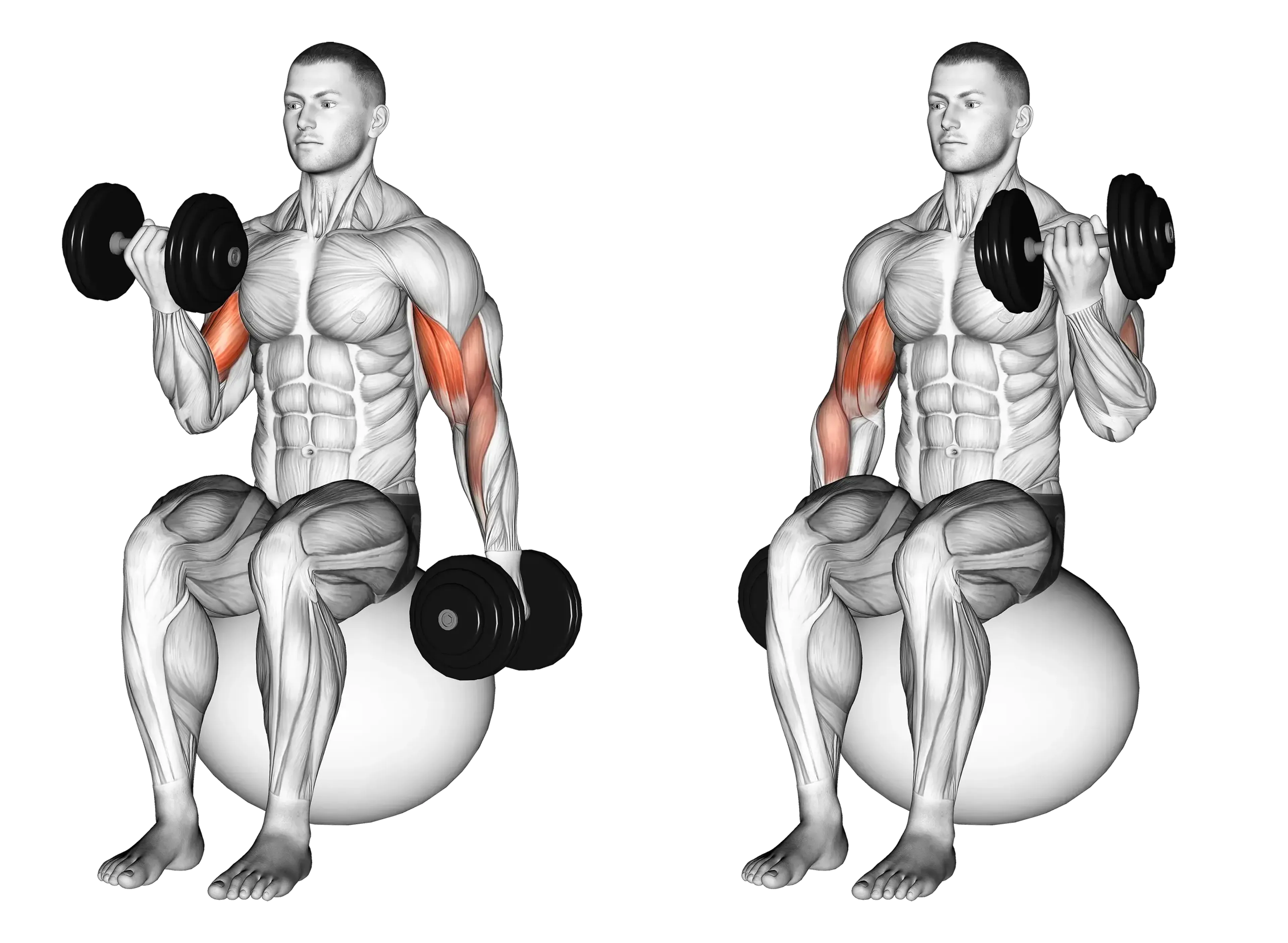
Dumbbell Exercise Ball Alternating Curl is an isolation exercise that primarily targets the biceps and also engages the forearms and core. It is a beginner-level movement that adds an alternating arm pattern to the standard exercise ball seated curl, which increases time under tension per arm and introduces an anti-rotation demand on the torso.
The alternating pattern means one arm curls while the other holds the dumbbell in the resting position. This unilateral loading creates a subtle rotational force that the core must resist to keep the body centered on the ball. The result is a movement that trains the biceps and develops trunk stability at the same time, making it more functionally demanding than a bilateral version.
Because each arm works independently, the alternating curl is useful for identifying and addressing strength or size imbalances between the left and right biceps. The lifter can pay close attention to the contraction quality on each side and ensure both arms are performing equal work, rather than letting the stronger arm compensate as can happen during simultaneous curling.
This exercise is closely related to the Dumbbell Exercise Ball Seated Curl, which uses the same setup but curls both dumbbells at once. The alternating version is a good progression from the bilateral version because it requires slightly more coordination and core engagement. It can also be compared to the Alternating Dumbbell Curl performed standing, with the ball adding the instability element.
The movement works well in arm-focused sessions, as a finisher after compound back or biceps work, or as part of a circuit-style training program where maintaining an elevated heart rate is desirable.
Muscles Worked
- Biceps Brachii
- Primary
- Brachialis
- High
- Brachioradialis
- Medium
- Flexor Carpi Radialis
- Low
- Rectus Abdominis
- Low
- Deltoid
- Minimal
- External Oblique
- Minimal
Instructions
- Sit upright on an exercise ball with your feet flat on the floor at shoulder width or slightly wider, holding a dumbbell in each hand with arms fully extended at your sides and palms facing forward.
- Brace your core and establish a stable seated position on the ball before beginning.
- Curl the dumbbell in your right hand upward by flexing at the elbow while keeping your upper arm stationary against your side.
- Continue curling until the dumbbell reaches shoulder height and the biceps are fully contracted.
- Squeeze the biceps briefly at the top, then lower the right dumbbell back to the starting position under control.
- Once the right arm returns to full extension, curl the left dumbbell upward using the same controlled motion.
- Continue alternating arms for the desired number of repetitions on each side.
- Keep your torso upright and resist the urge to lean or twist toward the working arm throughout the set.
Common Mistakes
Injuries
Dumbbell Exercise Ball Alternating Curl is a low risk exercise when performed with proper technique. The light to moderate loads typically used with this variation keep joint stress manageable, and the alternating pattern allows brief recovery between reps for each arm.
The elbow joint is the primary area to protect. Avoid hyperextending at the bottom of the curl or using a jerking motion to initiate the lift, as both can strain the biceps tendon and the connective tissue around the elbow. Control the weight through the full range of motion on every repetition.
The alternating arm pattern creates a slight asymmetric load on the torso. If your core is not adequately braced, you may lean toward the curling side, which can place uneven stress on the lower back over the course of a high-rep set. Keeping the feet wide and the abdominals engaged prevents this.
If you have existing balance or lower back concerns and find the ball too challenging, perform the Alternating Dumbbell Curl on a stable surface first and progress to the ball once your stability improves. Stop immediately if you feel any sharp pain in the elbow, wrist, or lower back.
Alternative Exercises

Frequently Asked Questions
- Q: Should I count reps per arm or total?
Count per arm. If your target is 12 reps, perform 12 curls with each arm for a total of 24 curls in the set.
- Q: Is alternating better than curling both arms together?
Alternating curls provide more time under tension per arm and add an anti-rotation challenge for the core. Bilateral curls are faster to complete and allow a slightly more balanced position on the ball. Both are effective and can be rotated in a training program.
- Q: Can I supinate during the curl for extra biceps activation?
Yes. Starting with a neutral grip at the bottom and rotating to a supinated position as you curl adds a supination component that increases biceps brachii recruitment. This is sometimes called a Zottman-style approach on the concentric phase.
- Q: What size exercise ball is best for this exercise?
Choose a ball that allows your thighs to be roughly parallel to the floor when seated. For most adults, a 55 cm to 65 cm ball works well. A properly sized ball ensures you can plant your feet securely and maintain good posture.
Overview
- Primary Focus:
- Biceps.
- Equipment:
- Dumbbell and exercise ball.
- Difficulty:
- Beginner.