Dumbbell Exercise Ball Preacher Curl

Overview
- Primary Focus:
- Biceps.
- Equipment:
- Dumbbell and exercise ball.
- Difficulty:
- Intermediate.
General Information
Dumbbell Exercise Ball Preacher Curl is an isolation exercise that primarily targets the biceps with strong involvement of the brachialis. It is an intermediate-level movement that uses an exercise ball in place of a traditional preacher bench, providing a curved surface for the upper arm to rest against while performing the curl.
The preacher position locks the upper arm in place and eliminates the ability to swing or use momentum, which places the biceps under constant tension throughout the range of motion. Using an exercise ball instead of a rigid pad introduces a slightly softer, more forgiving surface, and the kneeling position shown in the movement requires additional body awareness to keep the ball steady.
This variation isolates the biceps more effectively than standing or seated curls because the shoulder is held in a slight forward flexion. This position places a greater stretch on the long head of the biceps brachii at the bottom of the rep, which can contribute to muscle growth when trained through a full range of motion. The brachialis also works hard in this position, especially in the lower half of the curl.
The exercise is a practical alternative when a preacher bench is unavailable. It works well as an accessory movement after heavier pulling exercises like rows or pull-ups. Pairing it with a hammer grip variation such as the Dumbbell Exercise Ball Hammer Curl can provide comprehensive biceps and forearm development in a single session.
Because the kneeling setup and ball placement require some coordination, this movement is best suited for lifters who are already comfortable with basic curling mechanics and exercise ball stability.
Muscles Worked
- Biceps Brachii
- Primary
- Brachialis
- High
- Brachioradialis
- Medium
- Flexor Carpi Radialis
- Low
- Flexor Carpi Ulnaris
- Low
- Deltoid
- Minimal
- Rectus Abdominis
- Minimal
Instructions
- Kneel on the floor behind an exercise ball and drape one upper arm over the top of the ball so that it rests fully supported from the armpit to the elbow.
- Hold a dumbbell in the working hand with a supinated grip, palm facing up, and let the arm extend fully over the ball.
- Place the non-working hand on the ball for additional stability.
- Brace your core and keep your chest close to the ball to prevent it from rolling away.
- Curl the dumbbell upward by flexing at the elbow, keeping the upper arm pressed firmly against the ball.
- Continue curling until the forearm is nearly vertical and the biceps are fully contracted.
- Squeeze at the top for a brief pause, then slowly lower the dumbbell back to the starting position.
- Complete all repetitions on one arm before switching to the other side.
Common Mistakes
Injuries
Dumbbell Exercise Ball Preacher Curl is a medium risk exercise when performed with proper technique. The locked upper-arm position places significant stretch on the biceps tendon at the bottom of each rep, which requires careful load management.
The greatest concern is the fully extended position at the bottom of the curl. Dropping into the stretch too aggressively or using excessive weight can strain the distal biceps tendon or the structures around the elbow joint. Always control the eccentric phase and avoid hyperextending the elbow at the bottom.
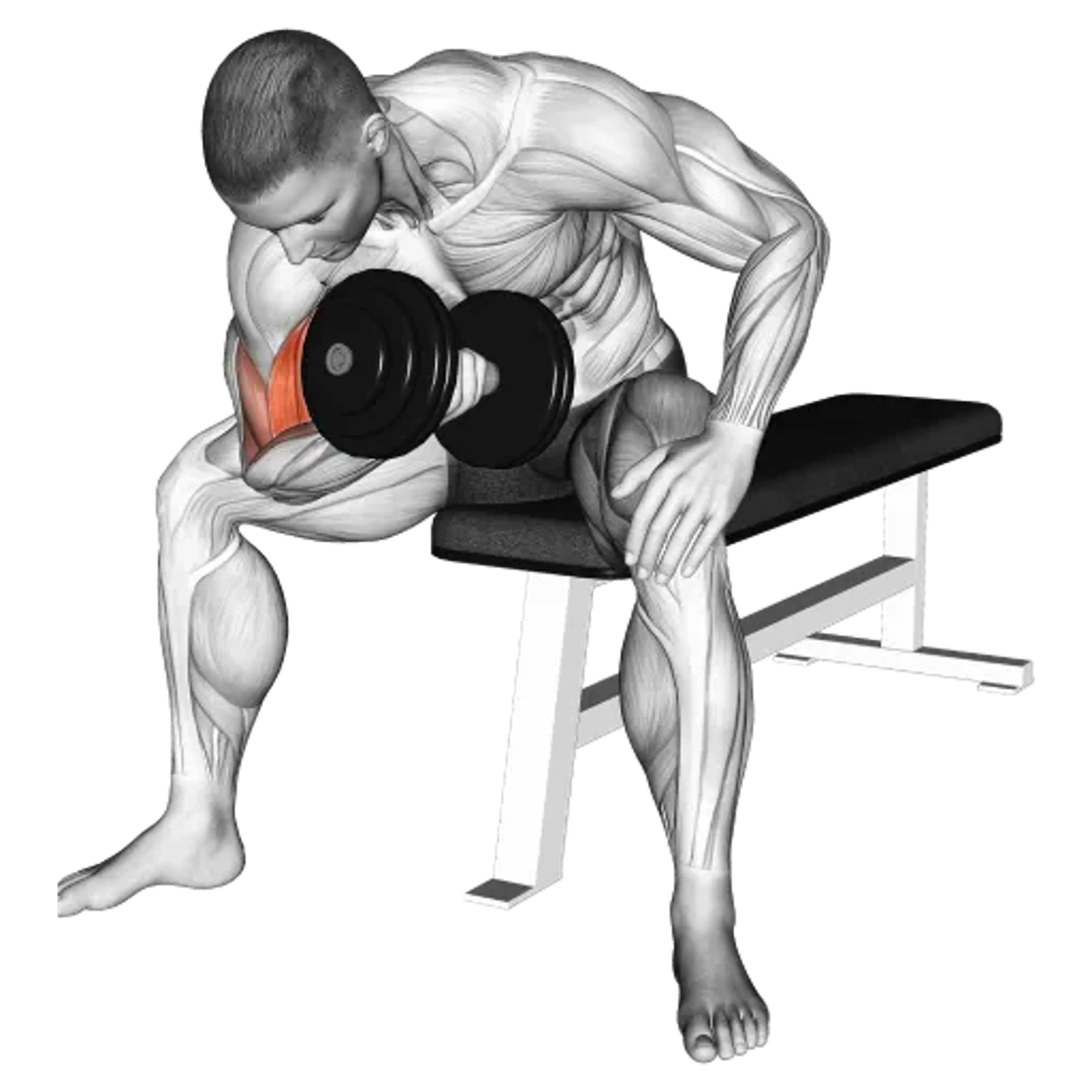
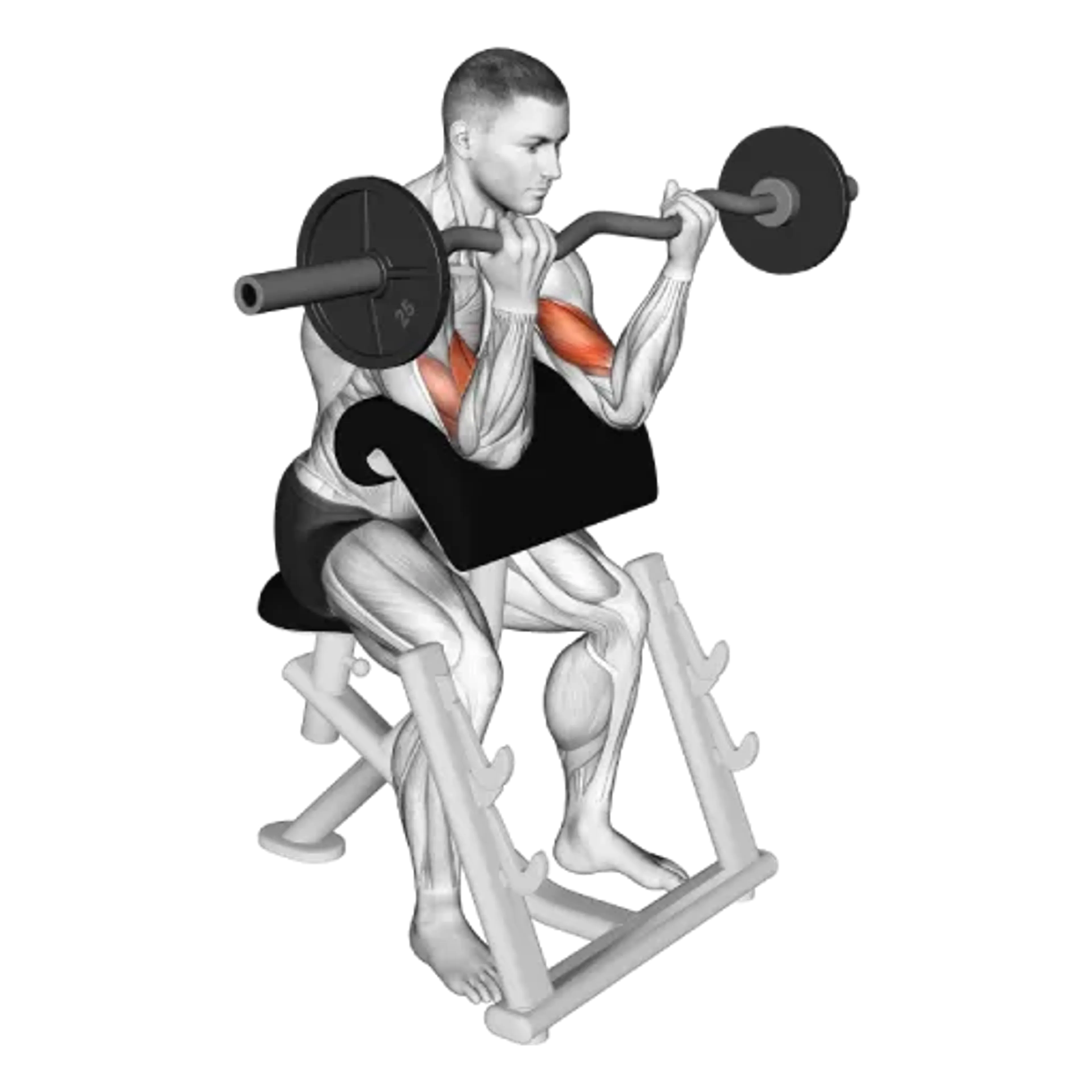
The kneeling position can create discomfort in the knees over time. Using a mat or folded towel under the knees reduces pressure. If knee issues are a concern, a standing variation over the ball or a traditional Barbell Preacher Curl on a supported bench may be more appropriate.
Stop the exercise immediately if you feel a sharp or pulling sensation in the inner elbow or the biceps tendon near the crook of the arm. Warm up thoroughly with lighter sets before working up to challenging loads, and consider limiting the bottom range of motion if you have a history of biceps or elbow tendon issues.
Alternative Exercises
Frequently Asked Questions
- Q: How is this different from a regular preacher curl?
The exercise ball provides a softer, more forgiving surface compared to a rigid preacher pad, and the kneeling setup requires more core engagement to keep the ball in place. The curling mechanics and muscle emphasis are very similar.
- Q: Should I train both arms at the same time?
This variation is best performed one arm at a time because using one arm allows you to stabilize the ball with the free hand. Training unilaterally also helps identify and correct strength imbalances between sides.
- Q: Can I use this as my main biceps exercise?
It can serve as a primary biceps movement in a session, though it works especially well as a secondary or finishing exercise after heavier compound pulls. The isolation and stretch emphasis make it ideal for hypertrophy-focused training.
- Q: What size exercise ball should I use?
A 55 cm or 65 cm ball works for most people. The ball should be large enough that your upper arm can rest comfortably on top while you kneel behind it without straining your shoulder.
Overview
- Primary Focus:
- Biceps.
- Equipment:
- Dumbbell and exercise ball.
- Difficulty:
- Intermediate.