Dumbbell Exercise Ball Hammer Curl
Overview
- Primary Focus:
- Biceps.
- Equipment:
- Dumbbell and exercise ball.
- Difficulty:
- Beginner.
General Information
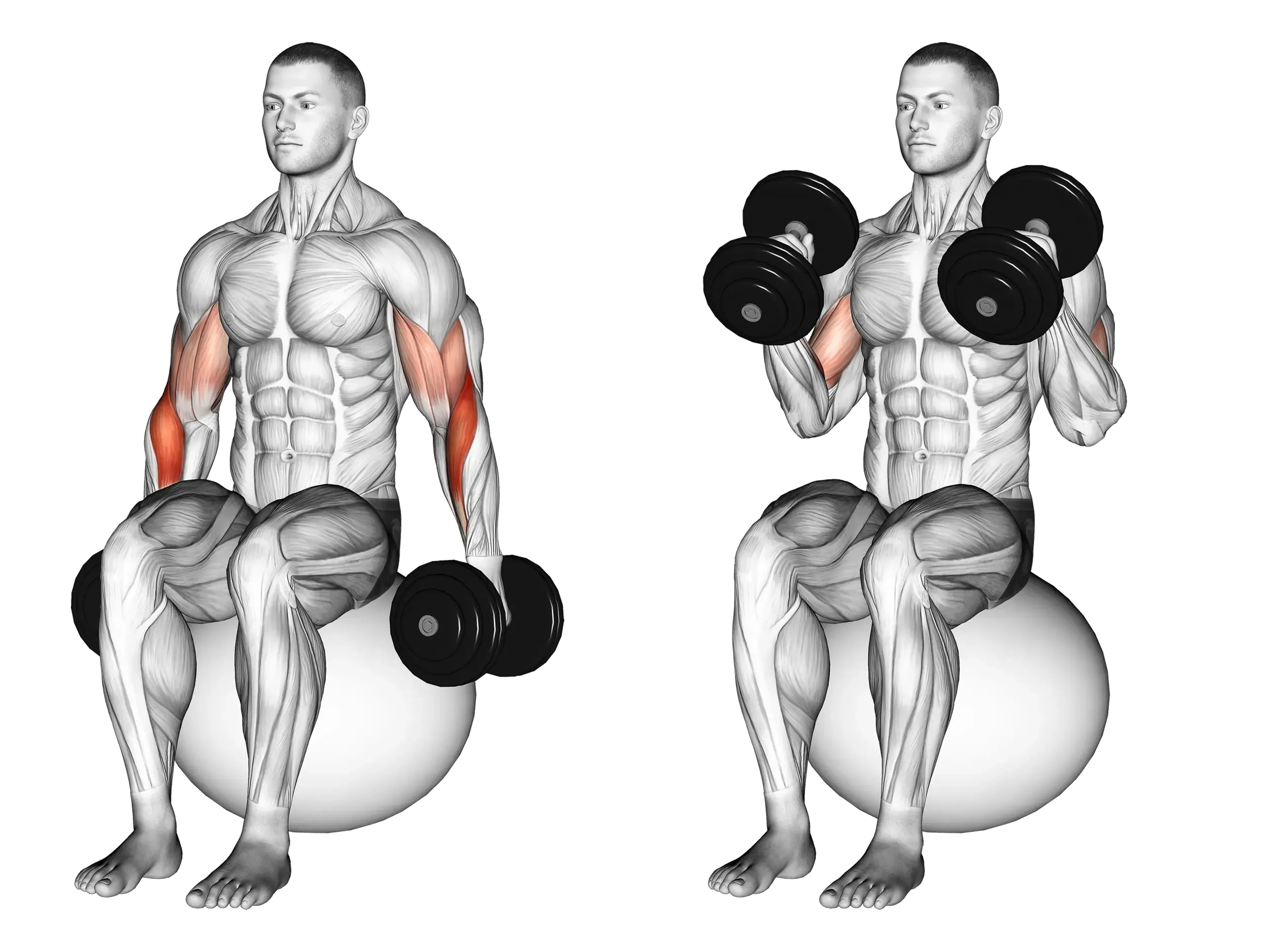
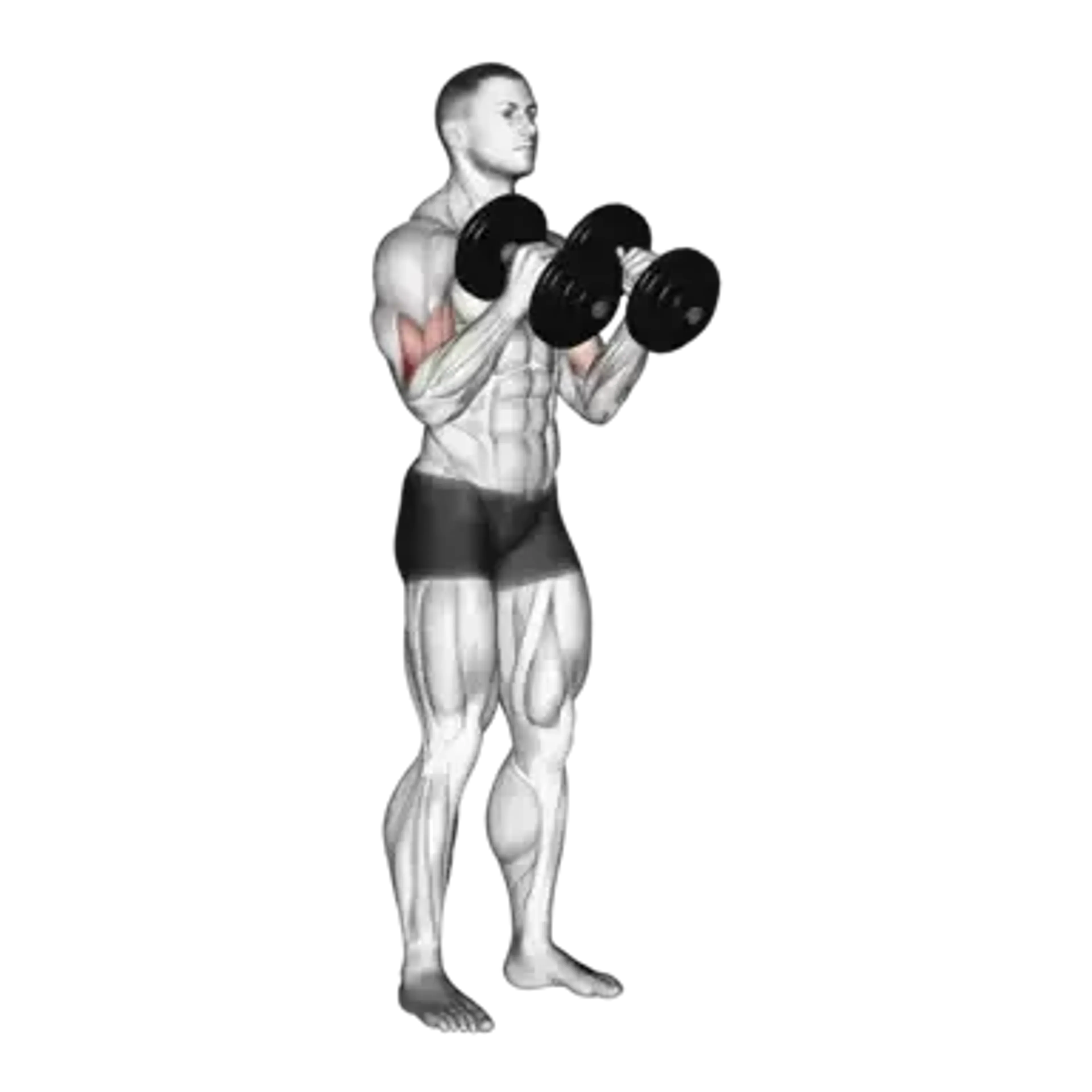
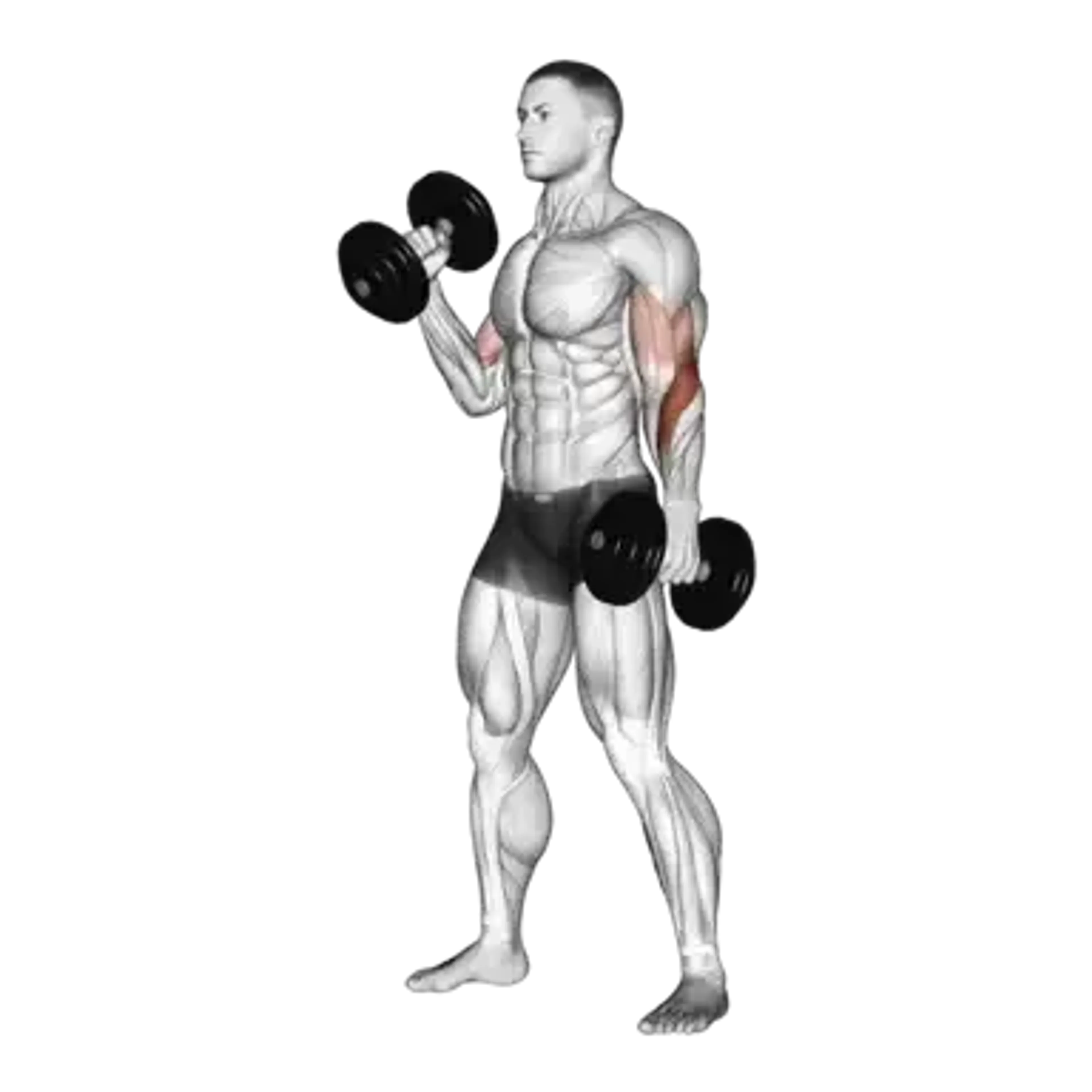
Dumbbell Exercise Ball Hammer Curl is an isolation exercise that primarily targets the biceps and brachioradialis, with strong involvement of the brachialis. It is a beginner-level movement that combines the neutral-grip hammer curl with the instability of an exercise ball to challenge both arm strength and core stability simultaneously.
The hammer grip, where the palms face each other throughout the movement, shifts emphasis toward the brachioradialis and brachialis compared to a standard supinated curl. This makes the exercise particularly effective for building forearm thickness and overall arm width. The neutral wrist position also tends to be more comfortable for individuals who experience wrist discomfort during traditional curls.
Seating on the exercise ball adds a proprioceptive challenge that encourages a braced core and upright posture. Because the ball can shift under load, lifters naturally adopt stricter curling form with less body English. This makes the movement a useful teaching tool for developing clean technique before progressing to heavier standing variations like the Dumbbell Hammer Curl.
The exercise fits well into arm-focused training days, upper body sessions, or full-body routines as an accessory movement. It pairs naturally with the Dumbbell Exercise Ball Seated Curl to train the biceps through both supinated and neutral grip patterns in one session.
Because the load is self-limiting due to the unstable surface, this exercise is accessible to beginners and also serves as a useful light-day or deload option for more experienced lifters.
Muscles Worked
- Biceps Brachii
- Primary
- Brachioradialis
- Primary
- Brachialis
- High
- Extensor Carpi Radialis
- Medium
- Flexor Carpi Radialis
- Low
- Rectus Abdominis
- Low
- Deltoid
- Minimal
Instructions
- Sit upright on an exercise ball with your feet flat on the floor at shoulder width, holding a dumbbell in each hand with a neutral grip so your palms face your thighs.
- Brace your core and press your feet firmly into the ground to create a stable base on the ball.
- Keeping your upper arms pinned to your sides, curl both dumbbells upward simultaneously by flexing at the elbows.
- Maintain the neutral grip throughout the movement so that your palms continue to face each other.
- Curl until the dumbbells reach shoulder height and you feel a strong contraction in the biceps and forearms.
- Pause briefly at the top of the movement.
- Lower the dumbbells back to the starting position in a controlled manner, fully extending the elbows.
- Keep your torso still and avoid leaning back or rocking on the ball throughout the set.
- Repeat for the desired number of repetitions.
Common Mistakes
Injuries
Dumbbell Exercise Ball Hammer Curl is a low risk exercise when performed with proper technique. The neutral wrist position reduces stress on the wrist joint compared to supinated curl variations, making it one of the more joint-friendly biceps exercises available.
The primary area to monitor is the elbow. As with all curling movements, using too much weight or swinging the dumbbells can stress the tendons that cross the elbow joint. Keep the load moderate and prioritize controlled repetitions to protect these structures.
The exercise ball introduces a minor balance risk. Ensure the ball is properly inflated, placed on a non-slip surface, and that your feet are wide enough to maintain stability. If balance is a significant concern, performing the Dumbbell Hammer Curl while standing or seated on a bench is a suitable alternative.
Discontinue the exercise if you feel sharp pain in the wrist, elbow, or forearm. Warming up with a few light sets before working sets helps prepare the tendons and connective tissue for the curling load.
Alternative Exercises
Frequently Asked Questions
- Q: What is the difference between a hammer curl and a regular curl?
A hammer curl uses a neutral grip with palms facing each other, which emphasizes the brachioradialis and brachialis more than a standard supinated curl. The supinated curl places greater demand on the biceps brachii specifically.
- Q: Can I alternate arms instead of curling both at once?
Yes. The Dumbbell Exercise Ball Alternating Curl uses an alternating pattern on the ball. You can apply the same alternating approach with a hammer grip to focus on one arm at a time.
- Q: Is this better than standing hammer curls?
Neither is inherently better. The exercise ball version enforces stricter form and adds a core stability component, while standing hammer curls allow heavier loads. Choose based on your training goal for the session.
- Q: How many sets and reps are recommended?
Three to four sets of 10 to 15 repetitions is a common approach for hypertrophy. Because the ball limits the weight you can use, moderate to high rep ranges tend to work best with this variation.
Overview
- Primary Focus:
- Biceps.
- Equipment:
- Dumbbell and exercise ball.
- Difficulty:
- Beginner.