Exercise Ball Body Saw

Overview
- Primary Focus:
- Core.
- Equipment:
- Exercise ball.
- Difficulty:
- Advanced.
General Information
Exercise Ball Body Saw is a compound exercise that primarily targets the core and also engages the shoulders and hip stabilizers. It is an advanced-level movement that demands significant anti-extension strength and total-body tension throughout the range of motion.
The exercise places you in a forearm plank position with your elbows on the exercise ball, then requires you to push your body forward and pull it back in a sawing motion. This small shift in leverage dramatically increases the demand on the rectus abdominis and obliques compared to a static Exercise Ball Plank, making it one of the more challenging ball-based core exercises available.
Because the ball is inherently unstable, the body saw forces deep stabilizers to fire constantly. The shoulders must work to control the ball path while the core resists spinal extension throughout each rep. This dual demand is what elevates the difficulty well beyond a standard plank variation.
The Exercise Ball Body Saw is best suited for individuals who have already mastered the Exercise Ball Plank and the Exercise Ball Rollout and are looking for a progression that further challenges anti-extension control. It fits well in core-focused training blocks or as a finisher in upper-body sessions.
Focus on maintaining a rigid torso throughout the movement. The moment you feel your lower back begin to sag, the set is effectively over. Quality of each rep matters far more than total volume with this exercise.
Muscles Worked
- Rectus Abdominis
- Primary
- Rectus Abdominis (Lower)
- Primary
- External Oblique
- High
- Deltoid
- Medium
- Erector Spinae
- Medium
- Serratus Anterior
- Medium
- Gluteus Maximus
- Low
- Triceps Brachii (Long Head)
- Low
- Rectus Femoris
- Minimal
Instructions
- Kneel behind an exercise ball and place your forearms on top of it, hands clasped together.
- Extend your legs behind you and rise into a forearm plank position with your body forming a straight line from head to heels.
- Brace your core tightly and squeeze your glutes to lock your pelvis in a neutral position.
- Slowly push your body forward by extending through the elbows, allowing the ball to roll away from you.
- Continue forward until you feel a strong stretch through the abdominals without letting your hips drop.
- Pause briefly at the end range.
- Pull your elbows back toward your body, rolling the ball back to the starting position.
- Maintain a flat back and engaged core throughout the entire movement.
- Repeat for the prescribed number of repetitions.
Common Mistakes
Injuries
Exercise Ball Body Saw is a high risk exercise when performed with proper technique. The extended lever arm and unstable surface place considerable demand on the lumbar spine and shoulders, so form breakdown can lead to problems quickly.
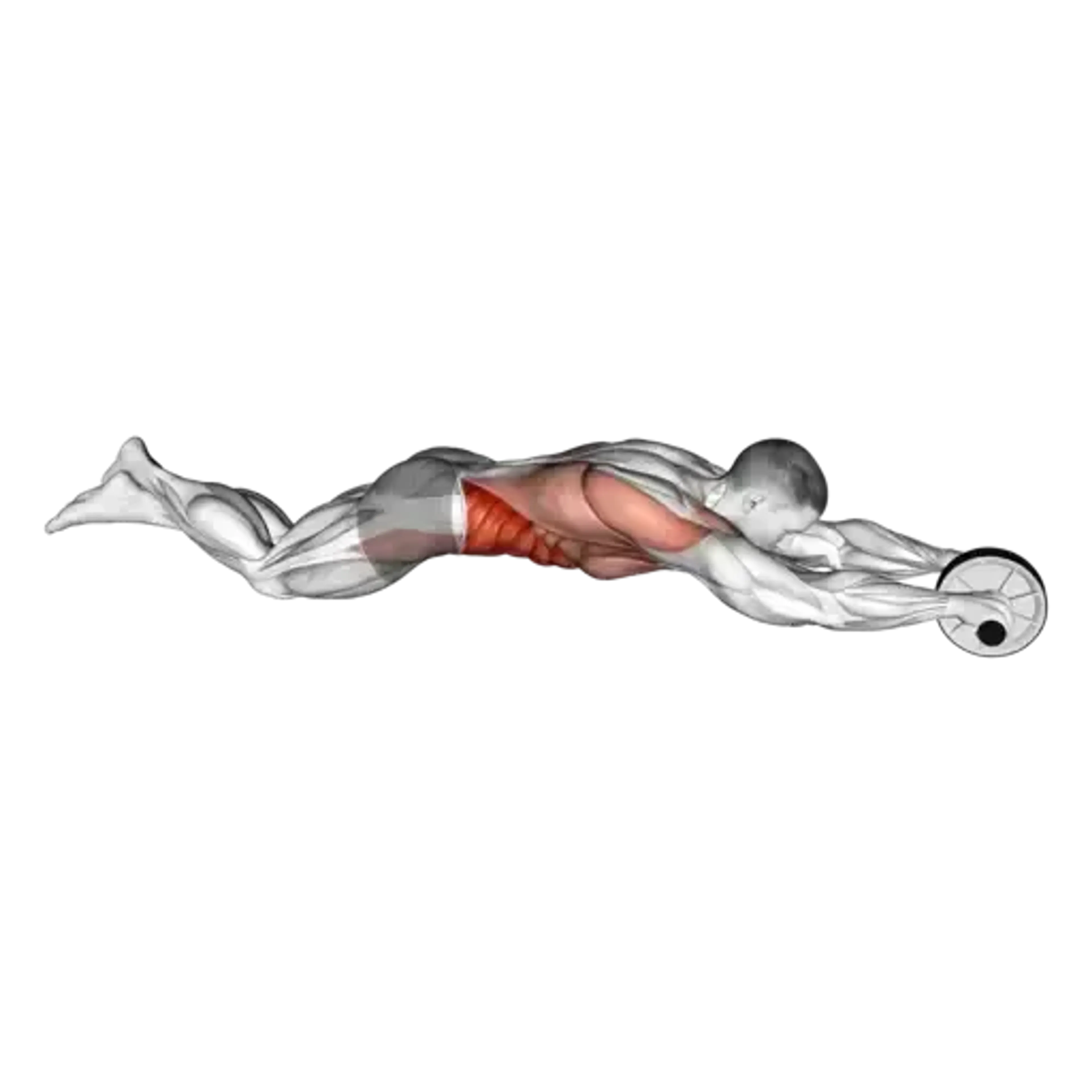
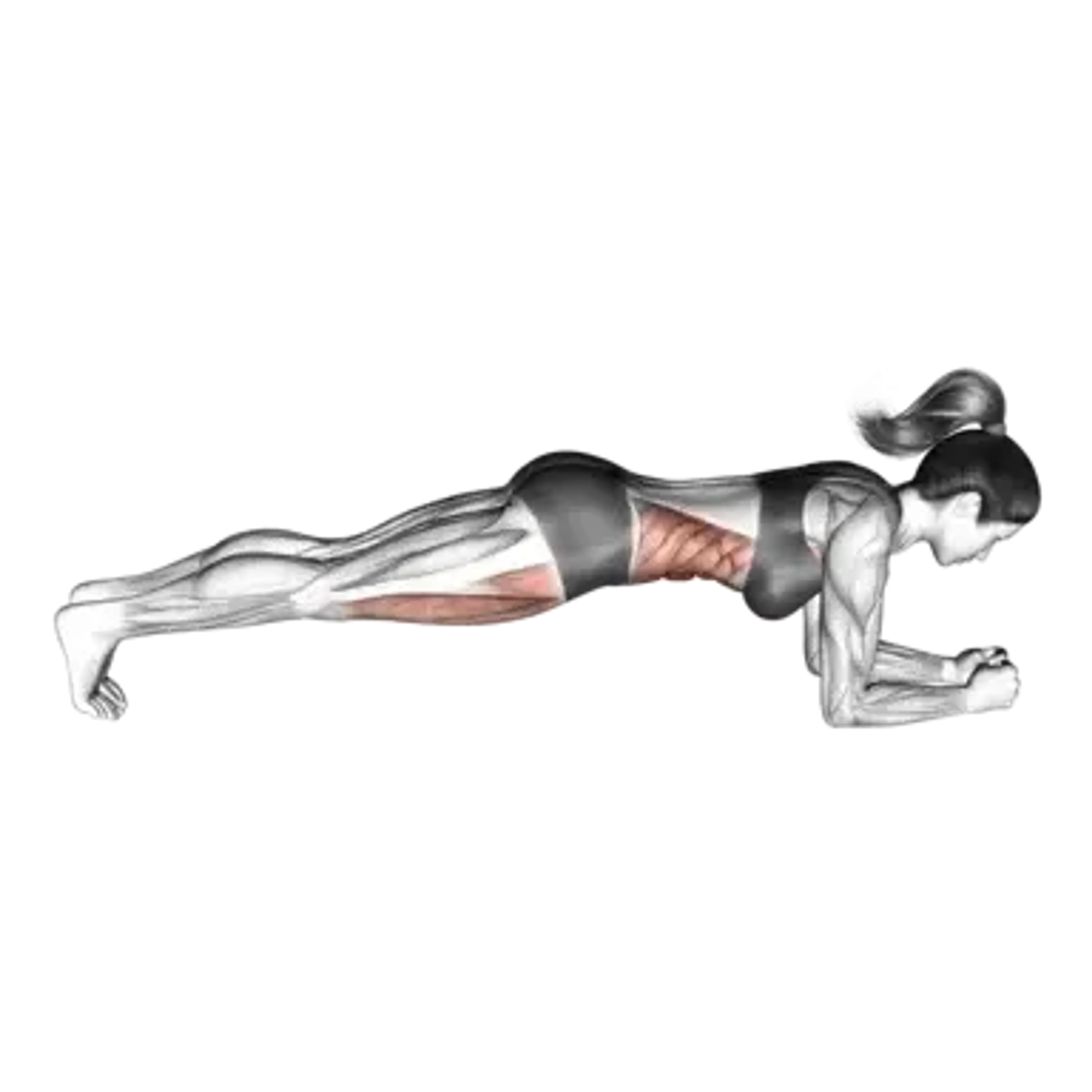
The primary concern is lower back strain from excessive lumbar extension. As you push forward, gravity pulls the hips toward the floor. If the core cannot resist this force, the lumbar spine hyperextends under load. Individuals with a history of disc issues or lower back pain should approach this exercise with caution and ensure they can hold a solid Exercise Ball Plank for at least 45 seconds before attempting the body saw.
Shoulder impingement is another consideration. The overhead reach position at full extension can compress the rotator cuff structures, particularly if you push too far forward. Keep the range of motion within a controllable distance and avoid forcing additional reach at the expense of shoulder comfort.
If you experience any sharp pain in the lower back, tingling in the extremities, or shoulder discomfort during the movement, stop immediately. Regress to the static plank on the ball or the Exercise Ball Rollout with a shorter range of motion until you build sufficient stability.
Alternative Exercises


Frequently Asked Questions
- Q: How does the body saw differ from an exercise ball rollout?
The Exercise Ball Rollout involves rolling the ball away from a kneeling position, while the body saw starts from a full plank and uses a forward-and-back shifting motion. The body saw places greater total-body demand because you must stabilize from the toes rather than the knees.
- Q: How many reps should I aim for?
Most people benefit from sets of 6 to 10 controlled reps. If you can exceed 12 reps without difficulty, slow the tempo or increase the range of motion to maintain the challenge.
- Q: Can I do this on a flat bench or floor instead?
You can perform a body saw on sliders or a flat surface, but the exercise ball adds an instability component that increases core activation. The ball version is harder, which is why it is classified as advanced.
- Q: What should I master before attempting this exercise?
You should be able to hold an Exercise Ball Plank for at least 45 seconds and perform the Exercise Ball Rollout with good form before progressing to the body saw.
Overview
- Primary Focus:
- Core.
- Equipment:
- Exercise ball.
- Difficulty:
- Advanced.