Exercise Ball Leg Curl

Overview
- Primary Focus:
- Upper legs.
- Equipment:
- Exercise ball.
- Difficulty:
- Intermediate.
General Information
Exercise Ball Leg Curl is an isolation exercise that primarily targets the hamstrings and also engages the glutes and calves. It is an intermediate-level movement that uses an exercise ball (also called a stability ball or Swiss ball) to create an unstable surface, demanding both strength and coordination throughout the posterior chain.
This exercise is particularly effective for building hamstring strength in a lengthened-to-shortened range of motion. Unlike machine-based lying leg curls which provide a fixed path of motion, the ball introduces a stability component that forces the core and hip stabilizers to work throughout each repetition. This makes it a functional choice for athletes and general trainees alike.
The movement closely mimics the hip extension and knee flexion pattern used in sprinting and jumping, making it a strong carryover exercise for sports performance. By keeping the hips elevated throughout the curl, the glutes remain active as synergists, which helps reinforce proper posterior chain recruitment.
Beginners who find this exercise too demanding can start with the exercise ball lying hip lift to build foundational hip bridge strength before progressing to the full curl. Those looking for an additional challenge can advance to the Exercise Ball Single-Leg Hamstring Curl, which doubles the load on each leg individually.
Focusing on a controlled eccentric (lowering) phase is key to getting the most out of this exercise. Allowing the ball to roll away slowly under tension places the hamstrings under a meaningful stretch, which is associated with greater muscle development over time.
Muscles Worked
- Biceps Femoris
- Primary
- Semitendinosus
- Primary
- Gluteus Maximus
- High
- Semimembranosus
- High
- Gastrocnemius (Lateral Head)
- Medium
- Gastrocnemius (Medial Head)
- Medium
- Erector Spinae
- Low
- Rectus Abdominis
- Low
Instructions
- Lie face up on the floor with your arms extended by your sides, palms down, and place your heels on top of the exercise ball.
- Brace your core and press your hips up off the ground so your body forms a straight line from shoulders to heels.
- Keep your hips elevated and pull the ball toward your glutes by bending your knees and driving your heels into the ball.
- Continue curling until your knees are bent to roughly 90 degrees and your feet are flat on the ball.
- Pause briefly at the top of the curl and squeeze your hamstrings and glutes.
- Slowly extend your legs to roll the ball back to the starting position while maintaining elevated hips.
- Repeat for the desired number of repetitions, keeping your hips from sagging throughout the set.
Common Mistakes
Injuries
Exercise Ball Leg Curl is a low risk exercise when performed with proper technique. The bodyweight-only load and smooth rolling motion of the ball make it generally safe for most trainees.
The primary area of concern is the hamstrings, which can cramp or strain if the muscle is not adequately warmed up or if the eccentric phase is rushed. Always perform a light warm-up set and ease into the full range of motion. Individuals with a history of hamstring pulls should start with partial range curls before progressing.
Lower back discomfort can occur if the hips drop during the movement, shifting the load onto the lumbar spine. Maintaining a strong glute contraction throughout the set prevents this. If you notice your lower back taking over, reduce the range of motion or regress to a static hip bridge on the ball.
Stop the exercise if you feel a sharp or sudden pain in the back of the thigh, behind the knee, or in the lower back. Mild muscular fatigue is expected, but any acute discomfort warrants rest and assessment.
Alternative Exercises


Frequently Asked Questions
- Q: How many reps should I aim for?
Most trainees benefit from 10 to 15 reps per set for 3 to 4 sets. If you can comfortably exceed 15 reps, consider progressing to the single-leg variation.
- Q: Can I do this exercise on a hard floor?
Yes, a hard floor actually works well because it prevents the ball from sinking into soft surfaces. A yoga mat under your upper back can add comfort without affecting ball movement.
- Q: What size exercise ball should I use?
A 55 to 65 cm ball works for most people. When your heels rest on top, your legs should be nearly straight with a slight bend in the knees at the start position.
- Q: How is this different from a machine lying leg curl?
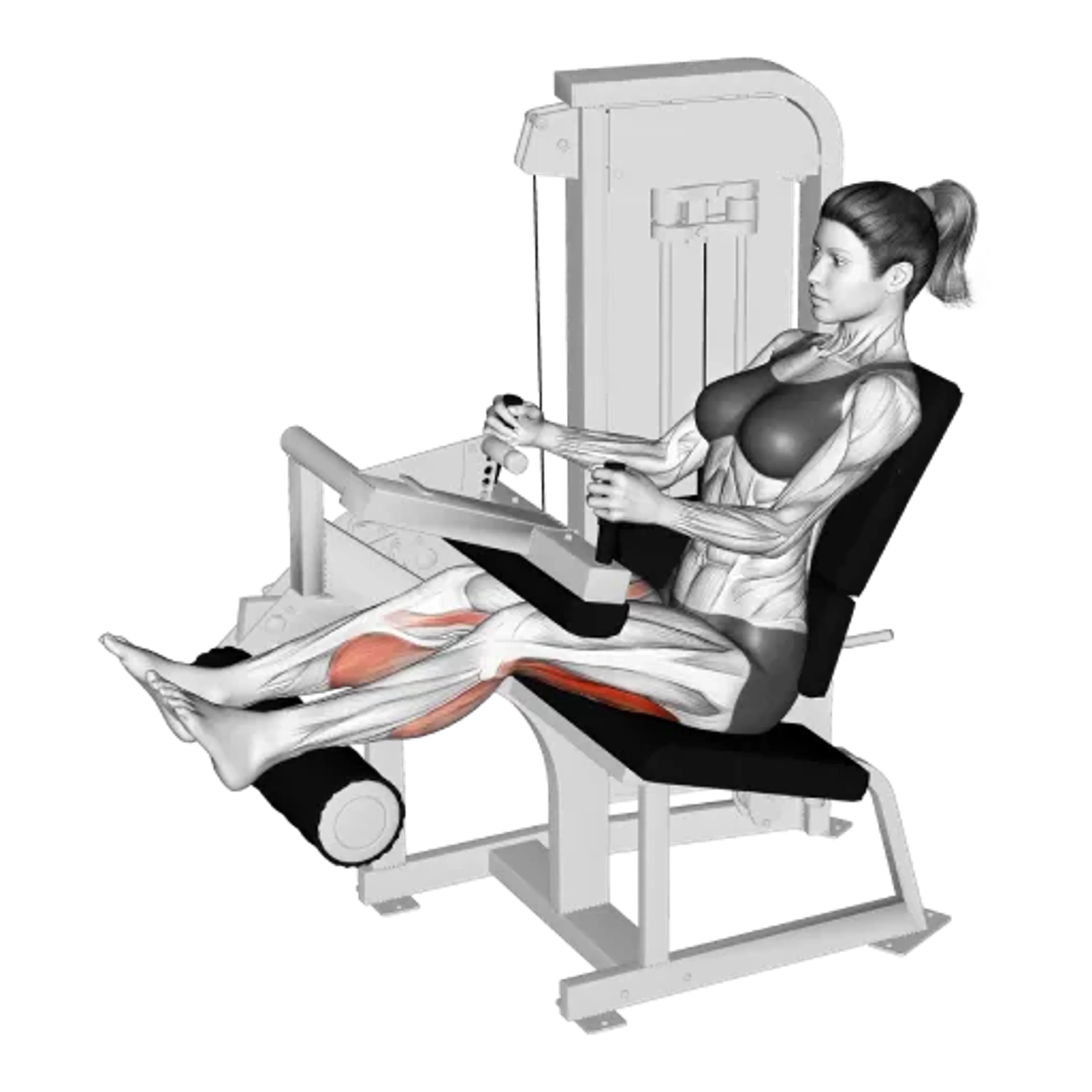
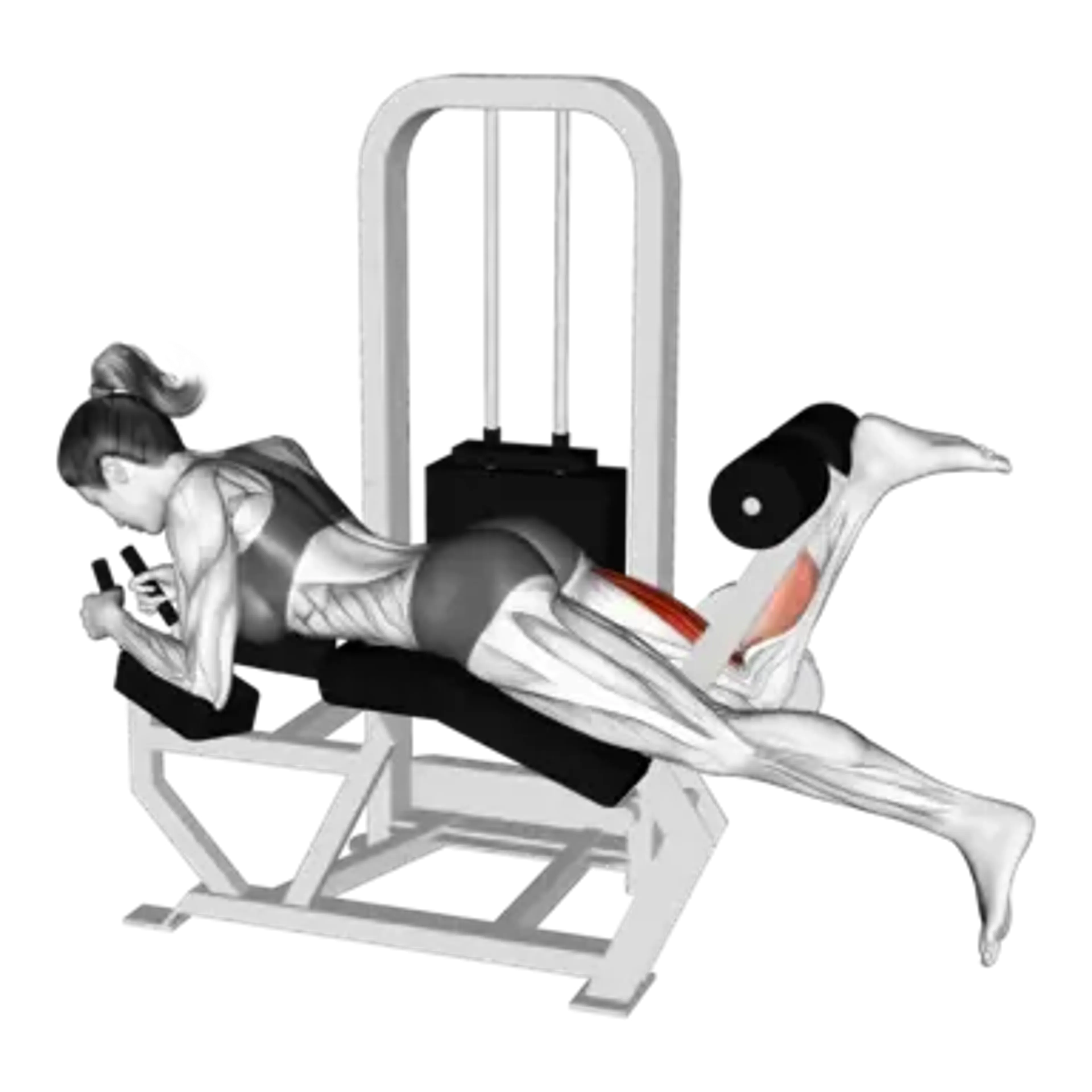
The exercise ball version requires you to stabilize your hips and core throughout the movement, whereas a machine provides a fixed path. This makes the ball variation more demanding on balance and overall posterior chain coordination.
Overview
- Primary Focus:
- Upper legs.
- Equipment:
- Exercise ball.
- Difficulty:
- Intermediate.