Exercise Ball Leg Extension Crunch

Overview
- Primary Focus:
- Core.
- Equipment:
- Exercise ball.
- Difficulty:
- Intermediate.
General Information
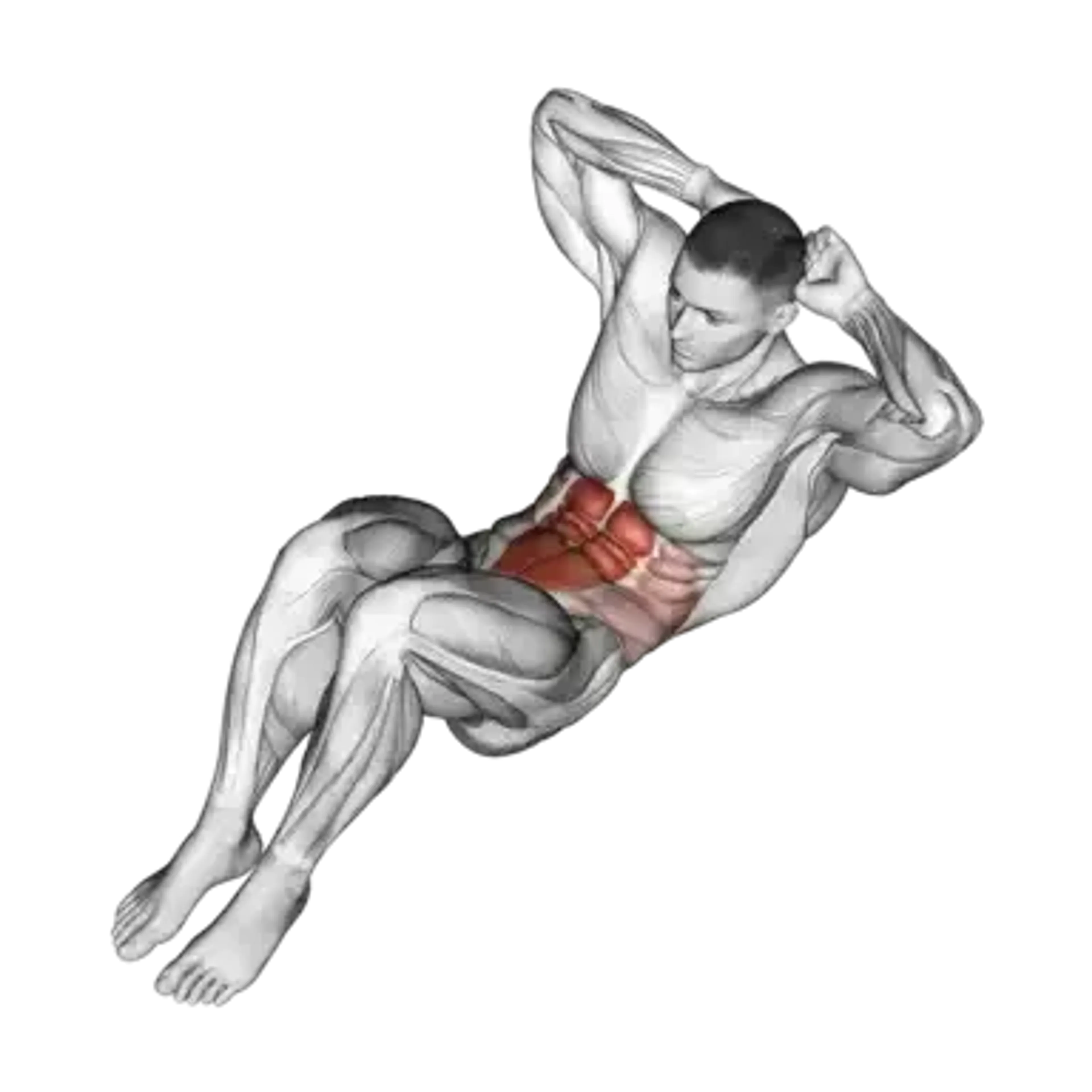
Exercise Ball Leg Extension Crunch is an isolation exercise that primarily targets the rectus abdominis and also engages the obliques and hip flexors. It is an intermediate-level movement that combines a crunch with a leg extension performed while gripping an exercise ball between the lower legs, creating a demanding dual-action contraction through the entire abdominal wall.
This exercise works by having you lie supine with the ball held between your calves and ankles, then simultaneously curling the upper body forward while extending the legs upward to bring the ball overhead. The coordination required to stabilize the ball forces the deep core muscles to fire continuously, making it a more effective variation than a standard crunch. The leg extension component also recruits the hip flexors and lower abdominals to a greater degree than floor-based crunches.
The Exercise Ball Leg Extension Crunch is well suited for lifters who have outgrown basic crunches and want to progress without adding external weight. Because the ball is relatively light, the difficulty comes from the increased range of motion and the coordination demand rather than raw load. This makes it a solid choice for hypertrophy-focused core blocks or as a finisher at the end of a training session.
Maintaining a strong mind-muscle connection with the upper and lower abdominals throughout each rep is essential. Focus on initiating the movement from the abs rather than using momentum from the arms or hip flexors. The ball should travel in a controlled arc, and the lower back should stay pressed into the floor during the crunch phase.
Muscles Worked
- Rectus Abdominis
- Primary
- Rectus Abdominis (Lower)
- Primary
- External Oblique
- High
- Rectus Femoris
- Medium
- Tensor Fasciae Latae
- Medium
- Adductor Longus
- Low
- Serratus Anterior
- Low
- Erector Spinae
- Minimal
Instructions
- Lie flat on your back with the exercise ball secured between your lower legs and ankles.
- Place your hands lightly behind your head or across your chest.
- Extend your legs so the ball is hovering just above the floor with your lower back pressed into the ground.
- Simultaneously curl your shoulders off the floor and raise the ball upward by bending at the hips and contracting your abs.
- Continue until your upper body and legs meet near the top, bringing the ball roughly above your midsection.
- Squeeze your abdominals hard at the peak contraction for a brief pause.
- Slowly lower your shoulders back toward the floor while extending the legs to return the ball to the starting position.
- Keep tension in your core throughout the eccentric phase and avoid letting the ball rest on the floor between reps.
Common Mistakes
Injuries
Exercise Ball Leg Extension Crunch is a medium risk exercise when performed with proper technique. The primary concern is excessive strain on the lower back if the lumbar spine lifts off the floor during the leg extension phase, which can compress the spinal discs under load from the hip flexors.
Individuals with existing lower back issues or hip flexor tightness should be cautious. If the lower back arches during the lowering phase, reduce the range of motion by not extending the legs as far toward the floor. A useful regression is the standard Exercise Ball Crunch, which removes the leg coordination component.
Avoid pulling on the neck with your hands, as this can strain the cervical spine. If you feel tension in the neck rather than the abs, switch to crossing your arms over your chest. Stop the exercise if you experience sharp pain in the lower back or hip flexors.
Alternative Exercises
Frequently Asked Questions
- Q: How is this different from a standard exercise ball crunch?
The leg extension component adds a lower abdominal and hip flexor demand that a standard Exercise Ball Crunch does not have. This makes the movement more challenging overall and works the core through a greater range of motion.
- Q: Can I use this as my main ab exercise?
It works well as a primary core movement for intermediate trainees. Pair it with a rotational exercise like the Exercise Ball Russian Twist for more complete core training.
- Q: What size exercise ball should I use?
A standard 55-65 cm stability ball works best. The ball only needs to be large enough to grip securely between your lower legs without slipping.
- Q: How many reps should I aim for?
Most lifters benefit from 12 to 20 reps per set. If you can easily exceed 20 reps with good form, slow down the tempo or add a longer pause at the top.
Overview
- Primary Focus:
- Core.
- Equipment:
- Exercise ball.
- Difficulty:
- Intermediate.