Exercise Ball Crunch

Overview
- Primary Focus:
- Core.
- Equipment:
- Exercise ball.
- Difficulty:
- Beginner.
General Information
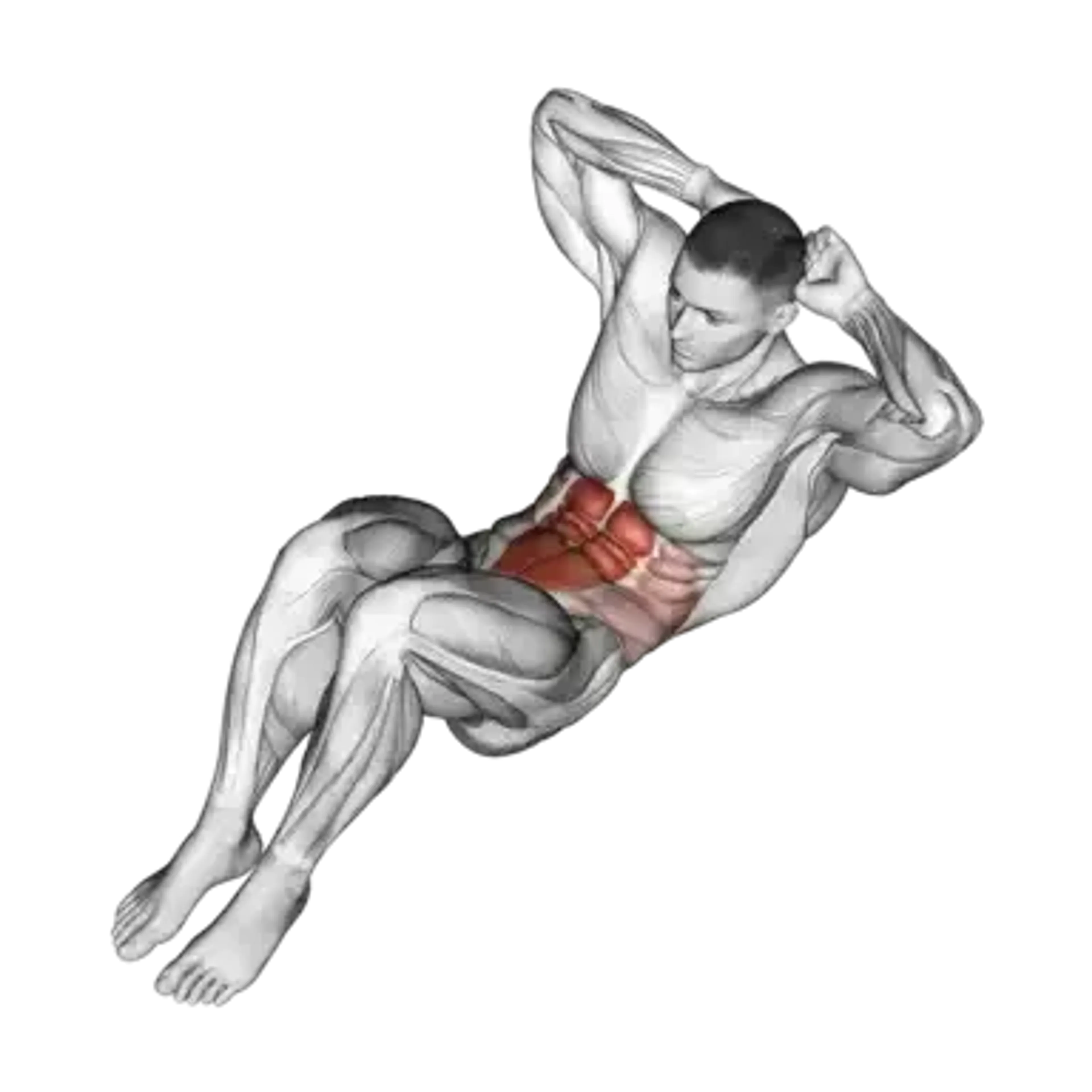
Exercise Ball Crunch is an isolation exercise that primarily targets the rectus abdominis and also engages the obliques for stabilization. It is a beginner-level movement that uses the unstable surface of an exercise ball to increase abdominal activation compared to a standard floor crunches.
The exercise ball positions the lower back in a slight extension at the bottom of the movement, allowing a greater range of motion than floor-based crunches. This extended range means the abdominals are loaded through a longer stretch, which can improve muscle recruitment and development over time. The instability of the ball also forces the deep stabilizer muscles of the core to engage throughout each repetition.
This movement is well suited for anyone looking to build foundational core strength without heavy external load. It works particularly well as part of a warm-up sequence, a high-rep finisher, or within a circuit-style core routine. Because the ball supports the lower back, it can feel more comfortable than crunching on a hard floor.
To get the most out of the Exercise Ball Crunch, focus on a deliberate contraction at the top of the movement rather than speed. The mind-muscle connection matters here: think about pulling the ribcage toward the pelvis while keeping the lower back pressed into the ball. Avoid using momentum or pulling on the neck. Once this variation becomes easy, progression options include the Weighted Exercise Ball Crunch or the Exercise Ball Sit-Up for a fuller range of motion.
Muscles Worked
- Rectus Abdominis
- Primary
- Rectus Abdominis (Lower)
- High
- External Oblique
- Medium
- Erector Spinae
- Low
- Rectus Femoris
- Low
- Serratus Anterior
- Minimal
- Tensor Fasciae Latae
- Minimal
Instructions
- Sit on the exercise ball and walk your feet forward until your lower back and hips rest firmly on the ball.
- Place your hands lightly behind your ears or crossed over your chest.
- Let your upper back extend slightly over the curve of the ball to establish the starting position.
- Brace your core and curl your torso upward by contracting your abdominals, lifting your shoulder blades off the ball.
- Pause briefly at the top of the crunch when you feel a strong contraction in your abs.
- Slowly lower your upper back down over the ball, returning to the extended starting position.
- Maintain steady foot pressure on the floor throughout to keep the ball stable.
- Repeat for the desired number of repetitions without letting momentum take over.
Common Mistakes
Injuries
Exercise Ball Crunch is a low risk exercise when performed with proper technique. The ball supports the lumbar spine, making it generally easier on the lower back than many other crunch variations.
The most common area of concern is the neck. Pulling on the head or tucking the chin aggressively can strain the cervical spine. Keep your hands light behind the ears and let the abdominals do the work. If you experience neck discomfort, try crossing your arms over your chest instead.
Individuals with lower back sensitivity should ensure the ball is properly sized so the hips and lower back are fully supported. If the ball is too small, the spine may hyperextend at the bottom of the movement, which could aggravate existing issues. Start with a shallow range of motion and increase it gradually as comfort allows.
Stop the exercise if you feel sharp pain in the lower back, neck, or hip flexors. A floor-based crunch or dead bug can serve as a suitable regression while building foundational core strength.
Alternative Exercises
Frequently Asked Questions
- Q: What size exercise ball should I use?
Choose a ball that allows your thighs to be roughly parallel to the floor when seated. For most adults, a 55 cm ball suits those under 5'6", a 65 cm ball for 5'6" to 6'0", and a 75 cm ball for taller individuals.
- Q: How is this different from a regular crunch?
The exercise ball allows a greater range of motion by letting the spine extend below neutral at the bottom. This increased stretch places more demand on the rectus abdominis. The unstable surface also recruits additional stabilizer muscles.
- Q: Can I add weight to this exercise?
Yes. Hold a weight plate or dumbbell against your chest or behind your head to increase resistance. This progression is commonly referred to as the Weighted Exercise Ball Crunch.
- Q: How many reps should I aim for?
Beginners can start with 3 sets of 12 to 15 reps. As you build endurance, increase to 20 or more reps per set, or add external resistance to keep the exercise challenging.
Overview
- Primary Focus:
- Core.
- Equipment:
- Exercise ball.
- Difficulty:
- Beginner.