Exercise Ball Side Bend

Overview
- Primary Focus:
- Core.
- Equipment:
- Exercise ball.
- Difficulty:
- Beginner.
General Information
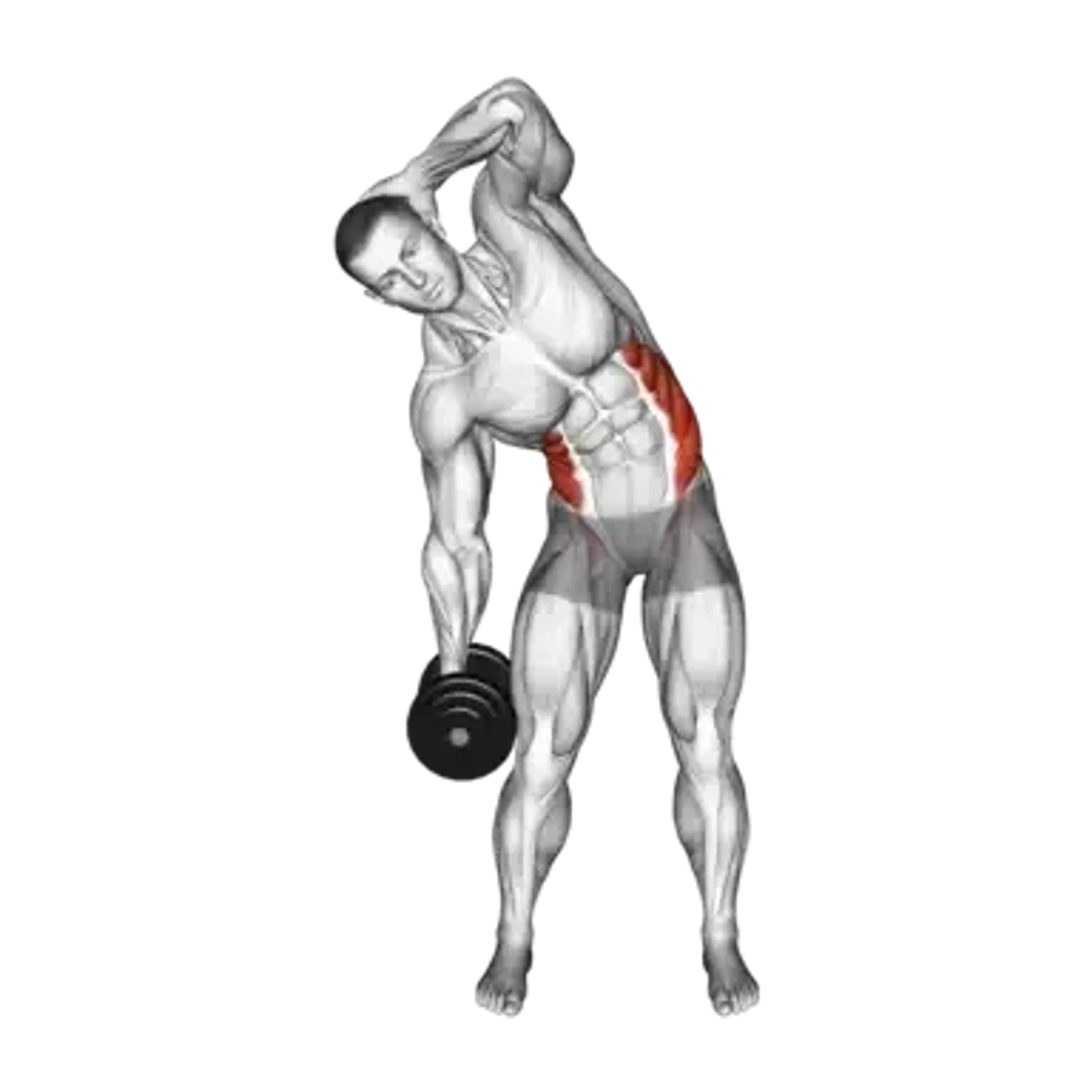
Exercise Ball Side Bend is an isolation exercise that primarily targets the obliques and also engages the erector spinae and rectus abdominis. It is a beginner-level movement that uses the curvature of the exercise ball to increase the range of motion available during lateral flexion, making it more effective than a standing Dumbbell Side Bend for isolating the obliques through a full stretch.
The exercise is performed by lying sideways over an exercise ball with the feet anchored against a wall or heavy object. The hands are placed behind the head, and the torso bends laterally over the ball before contracting the obliques to pull back up. The ball supports the hip and lower ribs, allowing the upper body to drape over it and achieve a deep pre-stretch at the bottom of the movement.
This extended range of motion is the primary advantage of the ball-based side bend. On a flat surface, lateral flexion is limited by the floor; here, the rounded surface lets the obliques work through a longer arc. This makes the exercise particularly useful for developing lateral trunk strength and improving the flexibility of the intercostal muscles.
The Exercise Ball Side Bend fits well into core circuits alongside frontal-plane exercises like the Exercise Ball Crunch and rotational movements like the Exercise Ball Russian Twist. Together, these cover all three planes of core movement.
Focus on a slow, controlled cadence. The obliques respond well to time under tension, and rushing through reps on an unstable surface reduces the quality of each contraction. Squeeze at the top and allow a full stretch at the bottom on every repetition.
Muscles Worked
- External Oblique
- Primary
- Erector Spinae
- Medium
- Rectus Abdominis
- Medium
- Adductor Longus
- Low
- Gluteus Medius
- Low
- Rectus Femoris
- Low
- Gluteus Maximus
- Minimal
Instructions
- Position the exercise ball next to a wall or sturdy surface that you can brace your feet against.
- Lie on your side over the ball so that it supports your hip and lower ribcage, with your legs extended and feet stacked or staggered against the wall for stability.
- Place both hands behind your head with elbows pointing outward.
- Allow your torso to drape over the ball, feeling a stretch along the top-side oblique.
- Contract the obliques on your upper side to lift your torso until your spine is straight or slightly past neutral.
- Pause briefly at the top of the movement and squeeze the oblique.
- Lower back down in a controlled manner to the stretched position.
- Complete all reps on one side, then switch to the other side.
Common Mistakes
Injuries
Exercise Ball Side Bend is a low risk exercise when performed with proper technique. The movement is relatively simple and the load is limited to bodyweight, which keeps joint stress minimal.
The primary area of concern is the lumbar spine. If the trainee rotates the torso during the side bend rather than staying in a pure lateral-flexion plane, asymmetric forces are placed on the spinal segments. Keep the chest open and facing forward throughout the movement to avoid this.
Individuals with existing oblique strains or rib injuries should approach carefully, as the deep stretch at the bottom position places significant lengthening force on the intercostal and oblique tissue. Start with a partial range of motion and increase gradually as comfort allows.
If you experience any sharp pain along the side of the ribcage, numbness radiating into the hip, or difficulty maintaining foot contact with the wall, stop the set and reassess your setup.
Alternative Exercises

Frequently Asked Questions
- Q: How do I anchor my feet if there is no wall nearby?
You can wedge your feet under a heavy piece of equipment like a loaded barbell or the base of a machine. A training partner can also hold your feet in place.
- Q: Can I hold a weight plate to increase difficulty?
Yes. Holding a weight plate against your chest or behind your head adds resistance. However, master the bodyweight version first to ensure your balance on the ball is solid.
- Q: How many reps should I aim for?
Start with 12 to 15 reps per side. Because this exercise relies on bodyweight, moderate to high rep ranges work best for building muscular endurance in the obliques.
- Q: Is this exercise suitable for people with scoliosis?
It can be, but only under guidance from a qualified professional. The lateral flexion may help strengthen imbalanced side musculature, though the deep stretch could aggravate certain curvatures.
Overview
- Primary Focus:
- Core.
- Equipment:
- Exercise ball.
- Difficulty:
- Beginner.