Weighted Exercise Ball Wall Squat
Overview
- Primary Focus:
- Upper legs.
- Equipment:
- Weight plate and exercise ball.
- Difficulty:
- Intermediate.
General Information
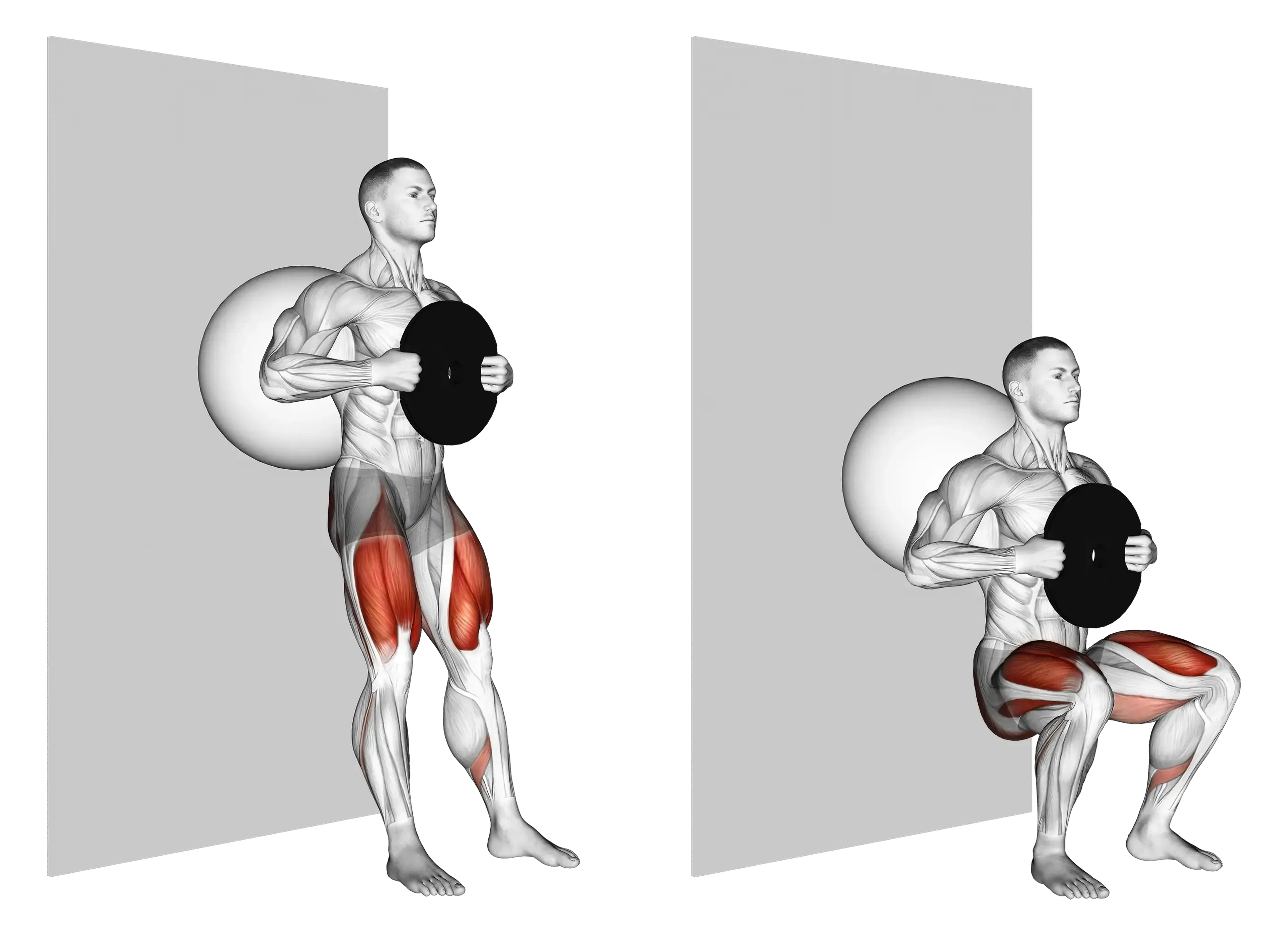
Weighted Exercise Ball Wall Squat is a compound exercise that primarily targets the quadriceps and also engages the glutes, adductors, core, and upper back. It is an intermediate-level movement that adds external dumbbell resistance to the standard Exercise Ball Wall Squat, increasing the strength-building potential of the exercise.
Holding dumbbells at the chest or by the sides while squatting against the ball allows for progressive overload without the balance demands of a free-standing loaded squat. This makes it a practical option for trainees who want to bridge the gap between bodyweight wall squats and barbell squatting movements like the barbell front squat or barbell squat.
The upright torso position created by the wall support shifts emphasis toward the quadriceps compared to a hip-dominant squat pattern. At the same time, the added weight increases the demand on the glutes and spinal erectors to maintain posture throughout the movement. Holding the dumbbells at chest height, as shown in the exercise, also involves the upper traps and shoulders isometrically.
This variation is well suited for hypertrophy-focused training with moderate to high rep ranges. It can serve as a primary lower body exercise for intermediate trainees or as an accessory movement for more advanced lifters who want additional quad volume without heavy axial loading.
Controlling the descent speed is especially important when holding extra weight. A 2 to 3 second lowering phase keeps tension on the quads and prevents the ball from shifting unpredictably against the wall.
Muscles Worked
- Rectus Femoris
- Primary
- Vastus Lateralis
- Primary
- Vastus Medialis
- Primary
- Gluteus Maximus
- High
- Adductor Longus
- Medium
- Erector Spinae
- Medium
- Gluteus Medius
- Medium
- Rectus Abdominis
- Low
- Upper Trapezius
- Low
Instructions
- Place an exercise ball between your lower back and a wall, then lean into it lightly to hold it in position.
- Hold a dumbbell at chest height with both hands, keeping your elbows close to your body.
- Set your feet shoulder-width apart, roughly one to two feet ahead of your hips, toes turned slightly outward.
- Brace your core and begin descending by bending your knees and hips, letting the ball roll down the wall behind you.
- Lower until your thighs reach parallel to the floor or slightly below, keeping your knees tracking over your toes.
- Pause briefly at the bottom position.
- Press through your heels to stand back up, rolling the ball up the wall to the starting position.
- Maintain an upright torso and steady grip on the dumbbell throughout each repetition.
- Repeat for the desired number of repetitions.
Common Mistakes
Injuries
Weighted Exercise Ball Wall Squat is a low risk exercise when performed with proper technique. The wall support reduces spinal loading compared to free-standing weighted squats, though the added dumbbell does increase the overall demand on the joints.
Knee stress is the primary concern. The vertical torso angle and forward knee travel inherent in wall squats place a notable load on the patellar tendon. Using a weight that allows controlled movement through the full range and positioning the feet far enough from the wall to keep the shins relatively vertical helps manage this. Trainees with patellar tendonitis should proceed cautiously and may benefit from limiting squat depth.
The lower back remains supported by the ball, but holding a heavy dumbbell at the chest shifts the center of gravity forward, which can increase lumbar extension if the core is not braced properly. Keep the abdominals tight throughout the set to maintain a neutral spine.
Stop the exercise if you feel sharp knee pain, the ball begins to slip, or you cannot control the descent with the selected weight. Reduce the load before compromising form.
Alternative Exercises




Frequently Asked Questions
- Q: Can I use two dumbbells instead of one?
Yes. Holding one dumbbell in each hand at your sides or at shoulder height are both valid options. The chest-hold position shown in the exercise keeps the load centered, which is easier to balance against the ball.
- Q: What weight should I start with?
Begin with a light dumbbell that allows you to complete 12 to 15 reps with perfect form. Most trainees start in the 10 to 20 pound range and increase gradually as the movement pattern feels stable.
- Q: How does this compare to a goblet squat?
Both exercises use a front-loaded weight and target the quads heavily. The wall squat removes the balance component and provides back support, making it easier to maintain depth. A goblet squat demands more core stability and hip mobility.
- Q: Should I use this or a barbell squat for building strength?
For maximal strength, the barbell squat allows far greater loading. The weighted wall squat is better suited as an accessory movement, a rehab exercise, or a primary lift for those not yet ready for barbell work.
Overview
- Primary Focus:
- Upper legs.
- Equipment:
- Weight plate and exercise ball.
- Difficulty:
- Intermediate.