Exercise Ball Frog Crunch

Overview
- Primary Focus:
- Core.
- Equipment:
- Exercise ball.
- Difficulty:
- Intermediate.
General Information
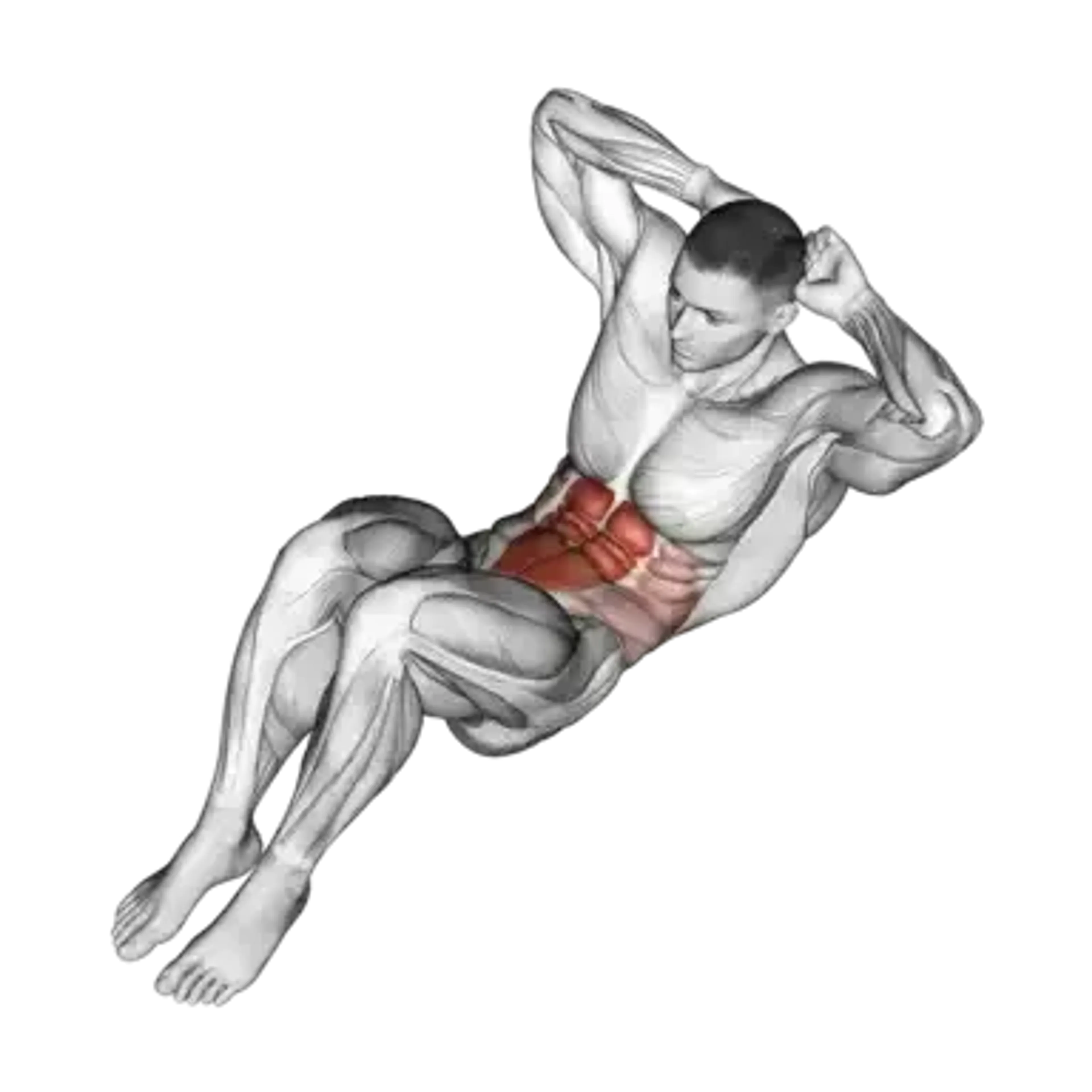
Exercise Ball Frog Crunch is a compound exercise that primarily targets the upper and lower abdominals and also engages the hip flexors and obliques. It is an intermediate-level movement that combines a crunch with a hip flexion component, using the exercise ball as both a load and a coordination tool.
The exercise is performed lying on your back, holding the exercise ball between your feet with knees bent outward in a frog-like position. You simultaneously crunch your upper body and bring the ball toward your chest, then extend back out. This dual-action pattern trains both the upper and lower portions of the rectus abdominis in a single movement, making it more demanding than a standard Exercise Ball Crunch or Exercise Ball Sit-Up.
The frog-leg positioning opens the hips and shifts some of the work away from the hip flexors compared to straight-leg variations like the Exercise Ball V-Up. This is beneficial for people who tend to feel hip flexor dominance during ab work, as the externally rotated position reduces the mechanical advantage of the iliopsoas.
Holding the ball between the feet adds a coordination challenge and a light adductor engagement throughout the set. The ball also serves as a useful feedback tool since dropping it indicates a loss of control or fatigue.
This exercise works well as a primary core movement in a training session or as part of a circuit with other exercise ball core variations like the Exercise Ball Pull-In or Exercise Ball Jack-Knife.
Muscles Worked
- Rectus Abdominis
- Primary
- Rectus Abdominis (Lower)
- Primary
- External Oblique
- High
- Rectus Femoris
- High
- Adductor Longus
- Medium
- Tensor Fasciae Latae
- Medium
- Deltoid
- Low
- Sartorius
- Low
- Erector Spinae
- Minimal
Instructions
- Lie on your back on the floor with your arms reaching overhead or behind your head.
- Place the exercise ball between your feet, bending your knees outward in a frog-leg position.
- Squeeze the ball firmly with your feet and engage your inner thighs to keep it secure.
- Brace your core and press your lower back into the floor.
- Simultaneously crunch your upper body off the floor and bring your knees toward your chest, drawing the ball in.
- Reach your hands toward the ball at the top of the movement.
- Pause briefly when the ball is closest to your chest and your abs are fully contracted.
- Slowly lower your upper body and extend your legs back to the starting position.
- Keep the ball controlled throughout and avoid letting it touch the floor between reps.
- Repeat for the prescribed number of repetitions.
Common Mistakes
Injuries
Exercise Ball Frog Crunch is a medium risk exercise when performed with proper technique. The supine position keeps spinal loading low, but the combined flexion demands on both ends of the body increase the effort required to maintain proper form.
The lower back is the primary area of concern. As the legs extend away from the body, the lumbar spine tends to arch off the floor if core engagement is lost. This repeated hyperextension under dynamic movement can irritate the lower back over time. Always ensure your lower back stays in contact with the floor, especially during the eccentric phase.
The hip flexors can become overworked if the frog-leg position is not maintained properly. If the knees straighten during the movement, the hip flexors take over from the abdominals. Individuals with hip flexor tightness or anterior pelvic tilt should be mindful of this tendency.
If you experience lower back discomfort, reduce the range of motion by not extending the legs as far from the body. If hip discomfort occurs from the frog-leg position, switch to a standard straight-leg variation or the Exercise Ball Pull-In as an alternative.
Alternative Exercises
Frequently Asked Questions
- Q: How does this compare to the Exercise Ball V-Up?
The Exercise Ball V-Up uses straight legs, which increases hip flexor involvement and lever arm length. The frog crunch uses bent, externally rotated legs, which reduces hip flexor dominance and places more direct tension on the abdominals.
- Q: What size exercise ball should I use?
A standard 55 to 65 cm ball works well for most people. The ball should be large enough to hold securely between your feet without straining to grip it.
- Q: Can I make this exercise easier?
Reduce the range of motion by not extending the legs as far from your body. You can also perform the crunch and hip flexion components separately before combining them.
- Q: How does the frog-leg position reduce hip flexor involvement?
Externally rotating the hips and bending the knees shortens the hip flexors and reduces their mechanical advantage, forcing the abdominals to do more of the work to bring the legs toward the chest.
Overview
- Primary Focus:
- Core.
- Equipment:
- Exercise ball.
- Difficulty:
- Intermediate.